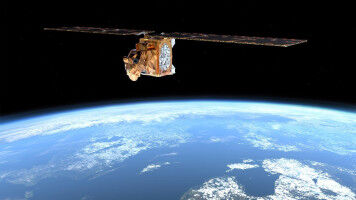
Zhang, et al., Nature Communications, 2022 Electrons in a Van Allen radiation belt (blue) encounter whistler waves (purple) and are sent raining toward the north pole (red). THEMIS satellites are seen near the radiation belt, while UCLA’s ELFIN hovers above Earth.
Zhang, et al. Nature Communications, 2022 Electrons in a Van Allen radiation belt ( blue ) encounter whistler waves ( purple ) and are sent raining toward the north pole ( red ). THEMIS satellites are seen near the radiation belt, while UCLA's ELFIN hovers above Earth. The downpours, which can affect satellites and space travel, are caused by electromagnetic whistler waves, scientists say The downpours, which can affect satellites and space travel, are caused by electromagnetic whistler waves, scientists say UCLA scientists have discovered a new energetic electrons raining down on Earth , a phenomenon that contributes to the colorful aurora borealis but also poses hazards to satellites, spacecraft and astronauts. The researchers observed unexpected, rapid "electron precipitation" from low-Earth orbit using the ELFIN mission , a pair of tiny satellites built and operated on the UCLA campus by undergraduate and graduate students guided by a small team of staff mentors. By combining the ELFIN data with more distant observations from NASA's THEMIS spacecraft, the scientists determined that the sudden downpour was caused by whistler waves, a type of electromagnetic wave that ripples through plasma in space and affects electrons in the Earth's magnetosphere, causing them to "spill over" into the atmosphere. Their findings, published March 25 Communications, demonstrate that whistler waves are responsible for far more electron rain than current theories and space weather models predict.
TO READ THIS ARTICLE, CREATE YOUR ACCOUNT
And extend your reading, free of charge and with no commitment.