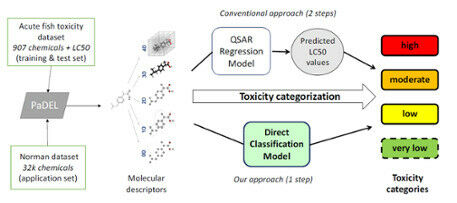
Overall workflow of the study, from the raw data to the finally generated models. Image taken from the ES&T paper.
Overall workflow of the study, from the raw data to the finally generated models. Image taken from the ES&T paper. Researchers of the University of Amsterdam, together with colleagues at the University of Queensland and the Norwegian Institute for Water Research, have developed a strategy for assessing the toxicity of chemicals using machine learning. They present their approach in an article in Environmental Science & Technology for the special issue "Data Science for Advancing Environmental Science, Engineering, and Technology". The models developed in this study can lead to substantial improvements when compared to conventional 'in silico' assessments based on Quantitative Structure-Activity Relationship (QSAR) modelling. According to the researchers, the use of machine learning can vastly improve the hazard assessment of molecules, both in the safe-by-design development of new chemicals and in the evaluation of existing chemicals. The importance of the latter is illustrated by the fact that European and US chemical agencies have listed approximately 800,000 chemicals that have been developed over the years but for which there is little to no knowledge about environmental fate or toxicity.
TO READ THIS ARTICLE, CREATE YOUR ACCOUNT
And extend your reading, free of charge and with no commitment.