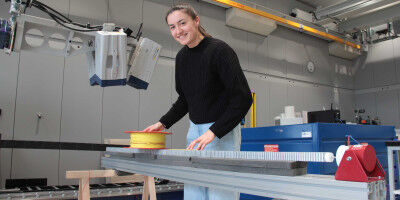
In Scheiben geschnittene Proben von Staubkörnern in einem Behälter. Foto: Jens Meyer (Universität Jena)
In Scheiben geschnittene Proben von Staubkörnern in einem Behälter. Foto: Jens Meyer (Universität Jena) - An international research team led by Tomoki Nakamura (Tohoku, Japan) has studied soil samples collected by the Japanese spacecraft Hayabusa-2 on the asteroid Ryugu. Falko Langenhorst of Friedrich Schiller University in Jena, Germany, was part of the group that gained insights into the formation of the asteroid and the unique processes that took place during the first five million years after the birth of our solar system from the analysis of the extraterrestrial material. Prof. Langenhorst has already had dust from the asteroid Itokawa, matter from Martian meteorites and interstellar dust collected in space by the NASA probe ,,Stardust" under his microscope. Most recently, his expertise as a meteorite scientist made him a member of a select international research team on the ,,Hayabusa-2" space probe mission to the asteroid Ryugu. Under the transmission electron microscope the Jenaer researcher examined minerals in the fragments of the stony small planet, which permit very concrete statements in astronomical dimensions to the "hour of birth" of the asteroid. What happened when and where in our solar system is now reported by the "Stone" team for the first time in an article in "Science".
TO READ THIS ARTICLE, CREATE YOUR ACCOUNT
And extend your reading, free of charge and with no commitment.