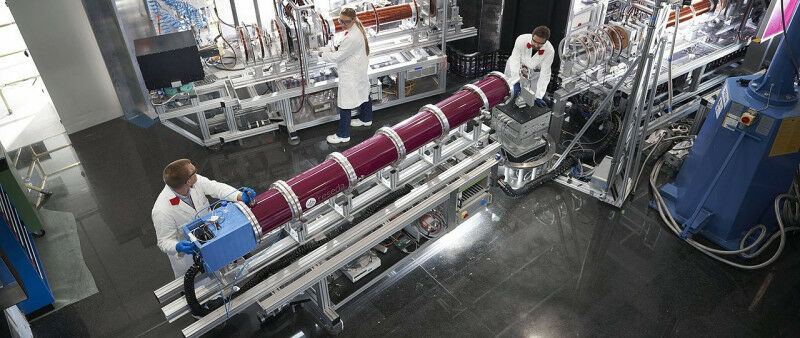
Researchers of the Heinz Maier-Leibnitz Center at the resonance spin echo spectrometer RESEDA at the Research Neutron Source Heinz Maier-Leibnitz (FRM II) of the Technical University of Munich. Image: Jan Greune / MCQST
Researchers of the Heinz Maier-Leibnitz Center at the resonance spin echo spectrometer RESEDA at the Research Neutron Source Heinz Maier-Leibnitz (FRM II) of the Technical University of Munich. Image: Jan Greune / MCQST - Just as electrons flow through an electrical conductor, magnetic excitations can travel through certain materials. Such excitations, known in physics as "magnons" in analogy to the electron, could transport information much more easily than electrical conductors. An international research team has now made an important discovery on the road to such components, which could be highly energy-efficient and considerably smaller. At present the transport and control of electrical charges forms the basis for most electronic components. A major disadvantage of this technology is that the flow of electric currents generates heat due to the electrical resistance. Considering the gargantuan number of electronic components in use worldwide, the loss of energy is immense.
TO READ THIS ARTICLE, CREATE YOUR ACCOUNT
And extend your reading, free of charge and with no commitment.