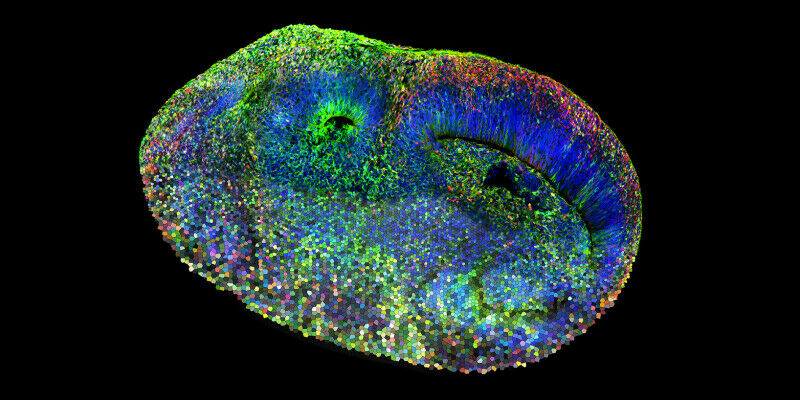
Microscopy image (upper half) and mosaic depiction (artistic representation, lower half) of a human brain organoid. Cells, each carrying a different mutation in a high-confidence autism gene, are stained differently. (Image: IMBA / Knoblich Lab)
Microscopy image (upper half) and mosaic depiction (artistic representation, lower half) of a human brain organoid. Cells, each carrying a different mutation in a high-confidence autism gene, are stained differently. (Image: IMBA / Knoblich Lab) The CRISPR-Cas gene scissors enable researchers to study the genetic and cellular causes of autism in the lab - directly on human tissue. How does autism develop? Which genes and cells in the human brain contribute to it? A new brain organoid model allows researchers from the Department of Biosystems at ETH Zurich in Basel and colleagues from Vienna to investigate these questions in human cells. Organoids are microtissue spheroids that are grown from stem cells and have a similar structure to real organs - in other words, they are miniature organs of sorts. With them, and with a new method for modifying genes within these organoids using the CRISPR-Cas gene scissors, the researchers found out which genetic networks in which cell types in the brain are responsible for the development of autism. "Our model offers unparalleled insight into one of the most complex disorders affecting the human brain and brings some much needed hope to clinical autism research," says Jürgen Knoblich, Professor and Scientific Director of the Institute of Molecular Biotechnology (IMBA) of the Austrian Academy of Sciences in Vienna and co-author of the study.
TO READ THIS ARTICLE, CREATE YOUR ACCOUNT
And extend your reading, free of charge and with no commitment.