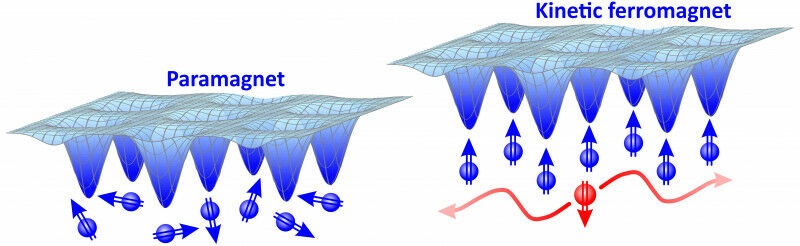
In the moiré material produced at ETH, the electron spins are disordered if there is exactly one electron per lattice site (left). As soon as there are more electrons than lattice sites (right) and pairs of electrons can form doublons (red), the spins align ferromagnetically as this minimizes the kinetic energy. (Illustration: ETH Zurich)
In the moiré material produced at ETH, the electron spins are disordered if there is exactly one electron per lattice site ( left ). As soon as there are more electrons than lattice sites ( right ) and pairs of electrons can form doublons ( red ), the spins align ferromagnetically as this minimizes the kinetic energy. (Illustration: ETH Zurich) Researchers have detected a new type of magnetism in an artificially produced material. The material becomes ferromagnetic through minimization of the kinetic energy of its electrons. For a magnet to stick to a fridge door, inside of it several physical effects need to work together perfectly. The magnetic moments of its electrons all point in the same direction, even if no external magnetic field forces them to do so. This happens because of the so-called exchange interaction, a combination of electrostatic repulsion between electrons and quantum mechanical effects of the electron spins, which, in turn, are responsible for the magnetic moments.
TO READ THIS ARTICLE, CREATE YOUR ACCOUNT
And extend your reading, free of charge and with no commitment.