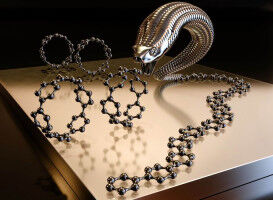
Artificial intelligence is helping in the search for active ingredients for tomorrow’s medicines. Image: AI generated with Midjourney (Visualisation: ETH Zurich)
Artificial intelligence is helping in the search for active ingredients for tomorrow's medicines. Image: AI generated with Midjourney (Visualisation: ETH Zurich) A new AI model developed by chemists at ETH Zurich can not only predict where a pharmaceutically active molecule can be chemically modified, but also how best to do it. This makes it possible to identify new pharmaceutical ingredients more quickly and improve existing ones in a targeted manner. New active pharmaceutical ingredients lay the foundations for innovative and better medical treatments. However, identifying them and, above all, producing them through chemical synthesis in the laboratory is no mean feat. To home in on the optimum production process, chemists normally use a trial-and-error approach: they derive possible methods for laboratory synthesis from known chemical reactions and then test each one with experiments; a time-consuming approach that is littered with dead ends. Now scientists at ETH Zurich, together with researchers from Roche Pharma Research and Early Development, have come up with an approach based on artificial intelligence (AI) that helps to determine the best synthesis method, including its probability of success.
TO READ THIS ARTICLE, CREATE YOUR ACCOUNT
And extend your reading, free of charge and with no commitment.