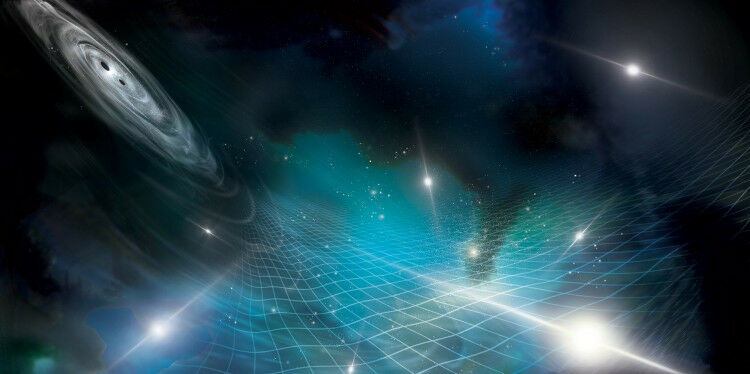
 Astrophysicists from the NANOGrav consortium have found convincing evidence of gravitational waves at very low frequencies for the first time. The artist’s impression shows how a series of pulsars are influenced by gravitational waves originating from a pair of supermassive black holes from a distant galaxy.
Astrophysicists from the NANOGrav consortium have found convincing evidence of gravitational waves at very low frequencies for the first time. The artist's impression shows how a series of pulsars are influenced by gravitational waves originating from a pair of supermassive black holes from a distant galaxy. Aurore Simonnet for the NANOGrav Collaboration - Data collected over 15 years provide the first compelling evidence for the existence of a low-frequency background noise from gravitational waves in the universe / Physicist Kai Schmitz from Münster University member of the collaboration - For the first time, astrophysicists have found compelling evidence for the existence of gravitational waves which oscillate with periods ranging from years to decades. This is shown in five articles which were published in The Astrophysical Journal Letters on June 29. For this, the researchers evaluated data which the North American Nanohertz Observatory for Gravitational Waves (NANOGrav) had collected over 15 years. Prof. Kai Schmitz from the University of Münster and Dr. Andrea Mitridate from DESY in Hamburg are involved in one of the research articles. This publication deals with the hypothesis that NANOGrav sees gravitational waves generated in the Big Bang.
TO READ THIS ARTICLE, CREATE YOUR ACCOUNT
And extend your reading, free of charge and with no commitment.
Your Benefits
- Access to all content
- Receive newsmails for news and jobs
- Post ads