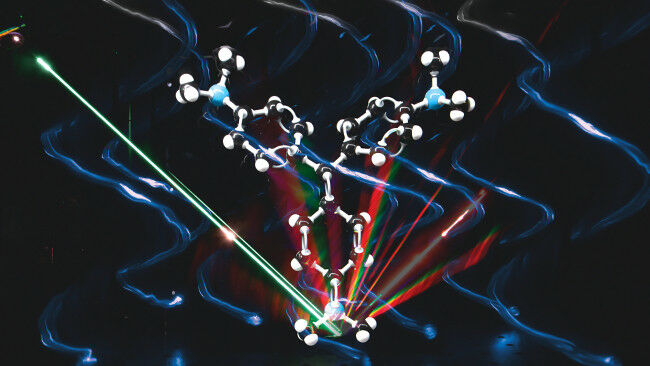
Crystal violet scatters light into a rainbow, revealing the strength of interaction between light and helical nanostructures (artist’s impression by photography). Image credit: Ventsislav Valev, Kylian Valev, Eva Valev, Robin Jones
Crystal violet scatters light into a rainbow, revealing the strength of interaction between light and helical nanostructures (artist's impression by photography). Image credit: Ventsislav Valev, Kylian Valev, Eva Valev, Robin Jones - New nanotechnology may make it easier to identify the chemical composition of impurities and their geometrical shape in samples of air, liquid and live tissue. Using conventional testing techniques, it can be challenging - sometimes impossible - to detect harmful contaminants such as nano-plastics, air pollutants and microbes in living organisms and natural materials. These contaminants are sometimes found in such tiny quantities that tests are unable to reliably pick them up. This may soon change, however. Emerging nanotechnology (based on a -twisted- state of light) promises to make it easier to identify the chemical composition of impurities and their geometrical shape in samples of air, liquid and live tissue. An international team of scientists led by physicists at the University of Bath is contributing towards this technology, which may pave the way to new environmental monitoring methods and advanced medicines.
TO READ THIS ARTICLE, CREATE YOUR ACCOUNT
And extend your reading, free of charge and with no commitment.