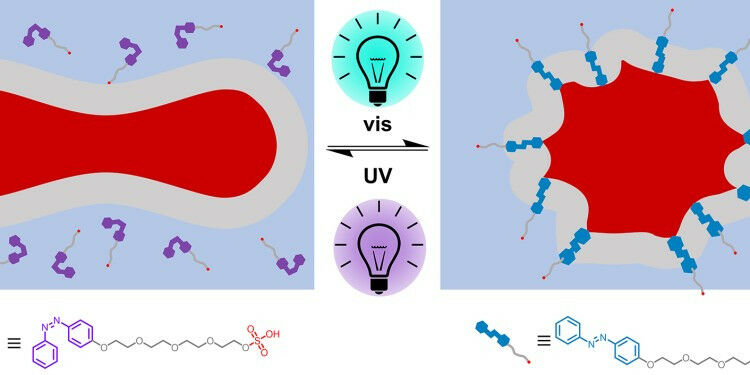
 A ’molecular light-switch’ in the cell membrane causes the cell to take on a burr-cell form (echinocyte, r.) or a flat form (similar to a discocyte), regardless of whether it is subjected to radiation with visual light or with ultraviolet light. © Adapted from Höglsperger F. et al., Nature Communications, DOI: 10.1038/s41467’023 -39032-0; licensed under CC BY licence.
Light-switchable molecules in membranes enable different forms of living cells to be studied. A 'molecular light-switch' in the cell membrane causes the cell to take on a burr-cell form (echinocyte, r.) or a flat form (similar to a discocyte), regardless of whether it is subjected to radiation with visual light or with ultraviolet light. Adapted from Höglsperger F. et al. Nature Communications, DOI: 10.1038/s41467'023 -39032-0; licensed under CC BY licence. Membranes fulfil a variety of tasks in living cells: for example, they separate the cells from their surroundings and thus protect them. Also, by means of transport proteins they convey the necessary nutrients to the interior. Membranes also play a major role when cells grow together to form tissue, when they proliferate by dividing, or when they move.
TO READ THIS ARTICLE, CREATE YOUR ACCOUNT
And extend your reading, free of charge and with no commitment.
Your Benefits
- Access to all content
- Receive newsmails for news and jobs
- Post ads