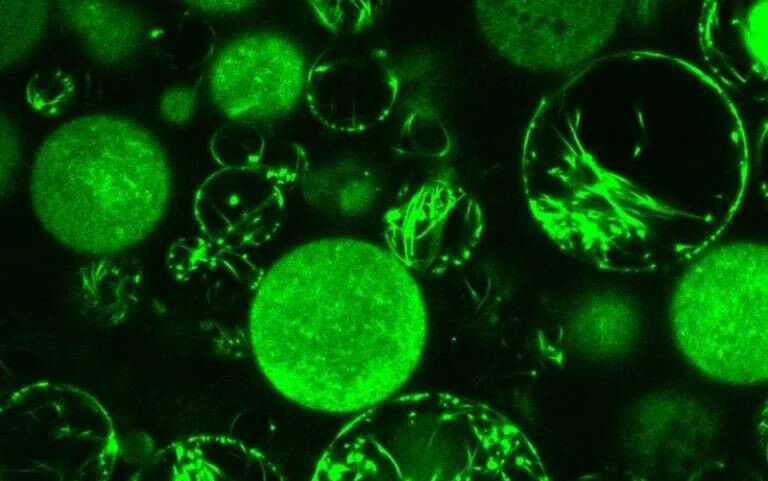
Confocal laser scanning microscopy image of the DNA fibers and nanotubes inside the protocells.
Confocal laser scanning microscopy image of the DNA fibers and nanotubes inside the protocells. The tiny tubes and thread-like structures that give cells their shape and help determine their function have been artificially re-created using strands of DNA in a study led by UCL researchers. The research, published in Nature Communications , represents a key step towards synthetic "smart cells" that could be used to sense diseases, deliver drugs or repair damaged cells inside the body. Cells, about a thousandth of a millimetre in size, are the fundamental units of all life. They contain "skeletons" made of proteins that fulfil a number of functions, such as providing structural support, helping the cell move around, and transporting materials within the cell. Re-creating these tubes and threads using proteins is challenging, so the researchers used strands of DNA as building blocks, and were able to precisely customise the structures' dimensions (from about 20 to 400 nanometres thick) and stiffness (from flexible to ultra-rigid). These tubes and threads were integrated inside cell-like sacs as well as coated on to the sacs' exterior - functioning as a cytoskeleton (inside the cell) or exoskeleton (outside the cell).
TO READ THIS ARTICLE, CREATE YOUR ACCOUNT
And extend your reading, free of charge and with no commitment.