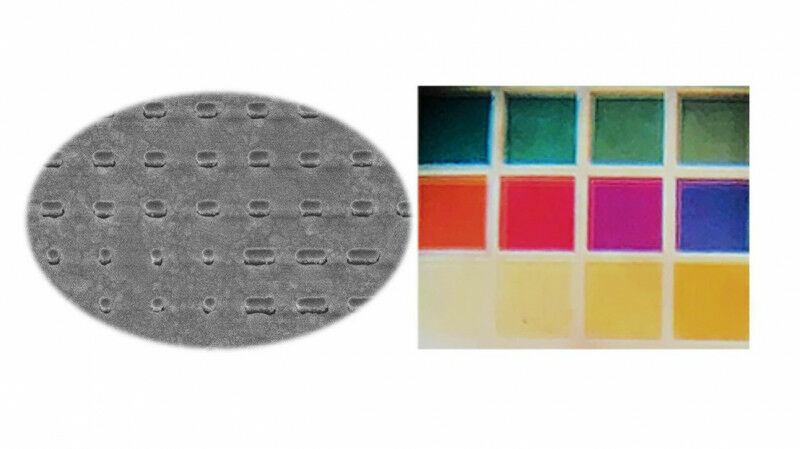
 Codable colors (R) reflected by the silver nanostuctures (L) developed in the Nanophotonics and Metrology Lab
Codable colors (R) reflected by the silver nanostuctures (L) developed in the Nanophotonics and Metrology Lab © NAM EPFL In a new approach to security that unites technology and art, researchers have combined silver nanostructures with polarized light to yield a range of brilliant colors, which can be used to encode messages. Cryptography is something of a new field for Olivier Martin, who has been studying the optics of nanostructures for many years as head of the Nanophotonics and Metrology Lab EPFL's School of Engineering. But after developing some new silver nanostructures in collaboration with the Center of MicroNanoTechnology , Martin and PhD candidate Hsiang-Chu Wang noticed that these nanostructures reacted to polarized light in an unexpected way, which just happened to be perfect for encoding information. They found that when polarized light was shone through the nanostructures from certain directions, a range of vivid and easily-identifiable colors was reflected back. These different colors could be assigned numbers, which could then be used to represent letters using the electronic communication standard code ASCII (American Standard Code for Information Interchange). To encode a secret message, the researchers applied a quaternary code using the digits 0, 1, 2 and 3 (as opposed to the more commonly used binary code 0 and 1). The result was a series of four-digit strings composed of different color combinations that could be used to spell out a message, and the method of chromo-encryption was born.
TO READ THIS ARTICLE, CREATE YOUR ACCOUNT
And extend your reading, free of charge and with no commitment.
Your Benefits
- Access to all content
- Receive newsmails for news and jobs
- Post ads