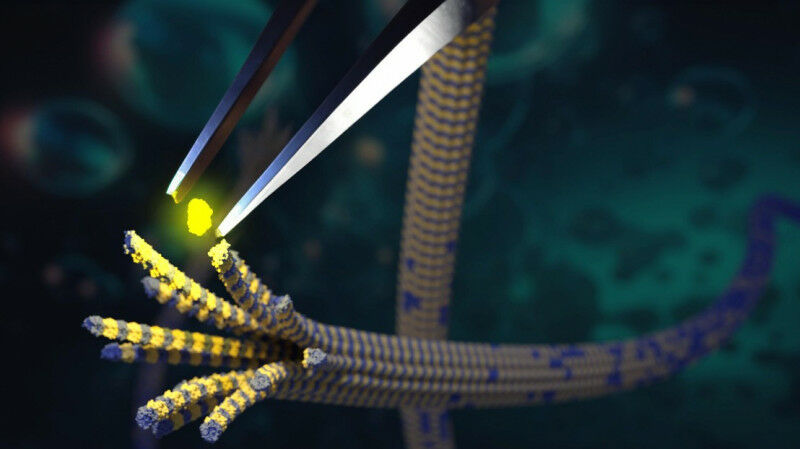
An illustration of tubulin handled by a metaphorical pair of tweezers. Credit: Beat Fierz (EPFL)
An illustration of tubulin handled by a metaphorical pair of tweezers. Credit: Beat Fierz (EPFL) - Tubulins are the building blocks of microtubules, which make up the cell's skeleton. A new method enables the detailed study of their role in diseases, including cancer. Tubulin is a protein that plays a crucial role in the structure and function of cells. It is the main component of microtubules, which are long, hollow fibers that provide structural support, help the cell divide, give it its shape, and act as tracks for moving molecular cargo around inside the cell. There are two types of tubulin: alpha-tubulin and beta-tubulin. Together, they form dimeric (two-part) building blocks, spontaneously assembling into microtubules that undergo further continuous cycles of assembly and disassembly.
TO READ THIS ARTICLE, CREATE YOUR ACCOUNT
And extend your reading, free of charge and with no commitment.