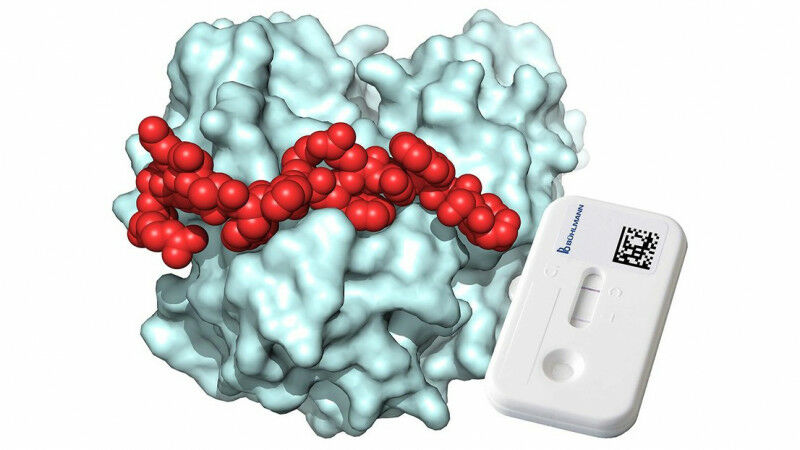
X-ray structure of the 18-amino acid peptide (red) bound to the inflammation marker calprotectin (light blue), with a lateral flow cassette. Credit: C. Heinis (EPFL)/J. Jourdan (BÜHLMANN AG)
X-ray structure of the 18-amino acid peptide ( red ) bound to the inflammation marker calprotectin ( light blue ), with a lateral flow cassette. Credit: C. Heinis (EPFL)/J. Jourdan (BÜHLMANN AG) Scientists have developed a peptide that binds to the protein calprotectin, a marker of major inflammatory disorders, and shown that it is suitable for diagnostic tests. The use of synthetic peptides for sensing disease markers is of great interest as they are more precise, robust, and cheaper than antibodies commonly used in diagnostic tests. Lateral flow assay detecting calprotectin in blood sample. Credit: Benjamin Ricken (BÜHLMANN AG)/Cristina Diaz-Perlas (EPFL) Common inflammatory disorders such as ulcerative colitis and Crohn's disease can be diagnosed or monitored by measuring the protein calprotectin in stool samples, while serum levels of calprotectin could be used to monitor the inflammation status in rheumatoid arthritis. Calprotectin concentrations in patient samples are typically determined using antibodies that bind and detect the protein, e.g. in lateral flow assays like the now all-too-familiar home COVID-19 test kits.
TO READ THIS ARTICLE, CREATE YOUR ACCOUNT
And extend your reading, free of charge and with no commitment.