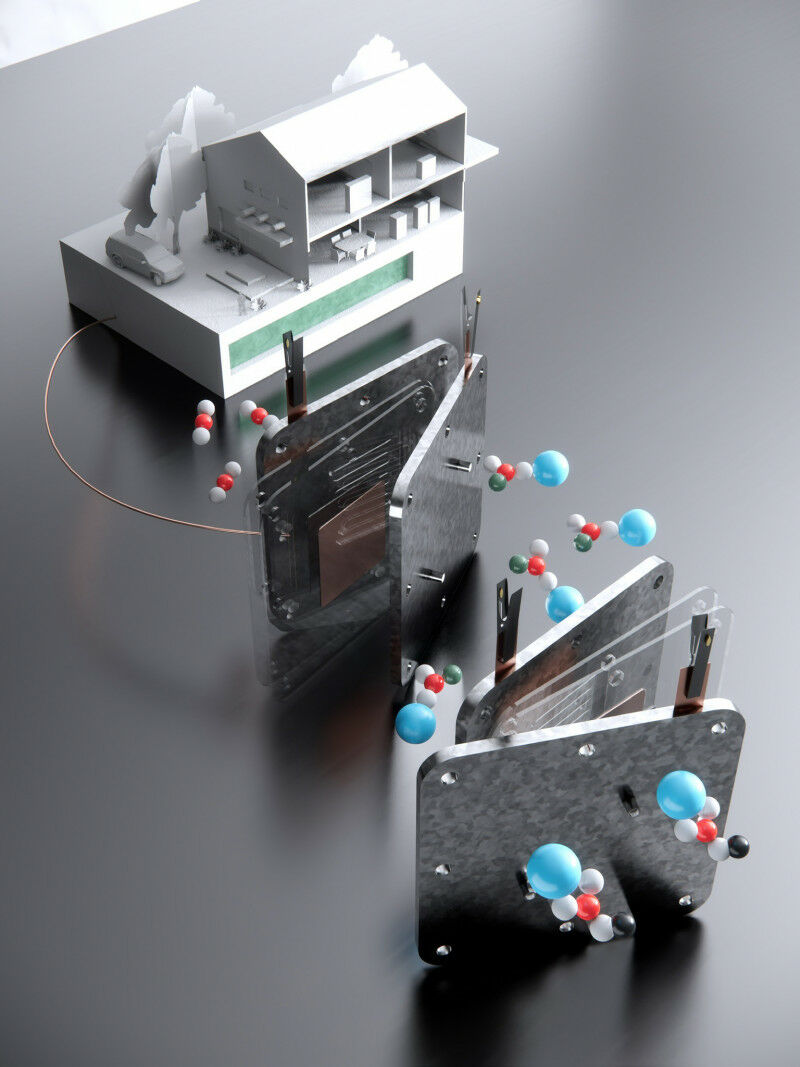
Rendering shows 3 parts as if on a grey table: a white model house on top; a fuel cell sandwiched in between two metal plates with spherical molecules floating around it; and on bottom is the electrolyzer, which looks similar to the fuel cell and has molecules floating around it. Credits : Image: Shuhan Miao, Harvard Graduate School of Design
Rendering shows 3 parts as if on a grey table: a white model house on top; a fuel cell sandwiched in between two metal plates with spherical molecules floating around it; and on bottom is the electrolyzer, which looks similar to the fuel cell and has molecules floating around it. Credits : Image: Shuhan Miao, Harvard Graduate School of Design The approach directly converts the greenhouse gas into formate, a solid fuel that can be stored indefinitely and could be used to heat homes or power industries. The search is on worldwide to find ways to extract carbon dioxide from the air or from power plant exhaust and then make it into something useful. One of the more promising ideas is to make it into a stable fuel that can replace fossil fuels in some applications. But most such conversion processes have had problems with low carbon efficiency, or they produce fuels that can be hard to handle, toxic, or flammable. Now, researchers at MIT and Harvard University have developed an efficient process that can convert carbon dioxide into formate, a liquid or solid material that can be used like hydrogen or methanol to power a fuel cell and generate electricity. Potassium or sodium formate, already produced at industrial scales and commonly used as a de-icer for roads and sidewalks, is nontoxic, nonflammable, easy to store and transport, and can remain stable in ordinary steel tanks to be used months, or even years, after its production.
TO READ THIS ARTICLE, CREATE YOUR ACCOUNT
And extend your reading, free of charge and with no commitment.