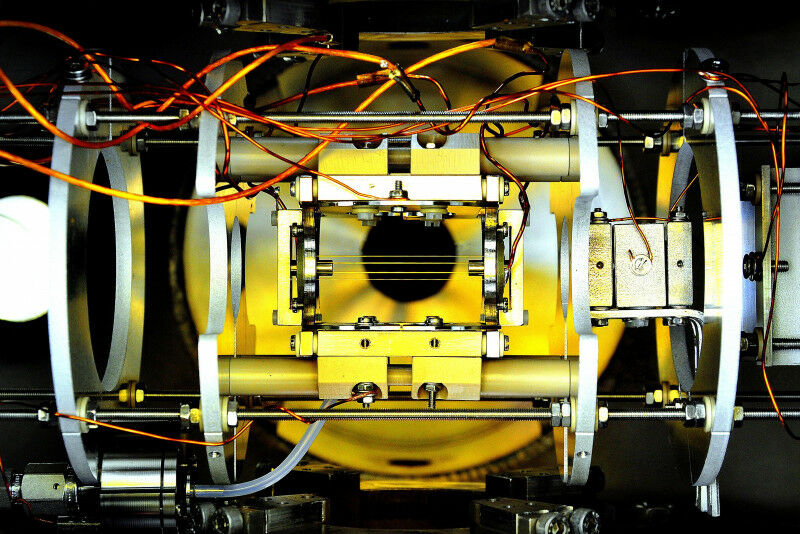
 Radio frequency trap, in which the negatively charged molecules are trapped and evaporated with light. |
Physicists from Heidelberg and Innsbruck develop technique for cooling negatively charged molecules. Radio frequency trap, in which the negatively charged molecules are trapped and evaporated with light. Heidelberg University Molecular anions, negatively charged molecules, are difficult to cool due to their specific electronic configuration. A team of physicists led by Matthias Weidemüller from Heidelberg University's Institute for Physics and Roland Wester from the Department of Ion Physics and Applied Physics at the University of Innsbruck (Austria) have now developed a new method for cooling molecular anions to below three Kelvin, i.e. approximately minus 270 degrees Celsius, in a short time. According to the researchers, this enables, for example, new investigations of chemical reactions in space. Cooling atoms and ions to near absolute zero - which is at zero Kelvin or minus 273,15 degrees Celsius - is routine in many laboratories today. As the particles can be very well controlled at these temperatures such systems provide an ideal platform for exploring many scientific questions.
TO READ THIS ARTICLE, CREATE YOUR ACCOUNT
And extend your reading, free of charge and with no commitment.
Your Benefits
- Access to all content
- Receive newsmails for news and jobs
- Post ads