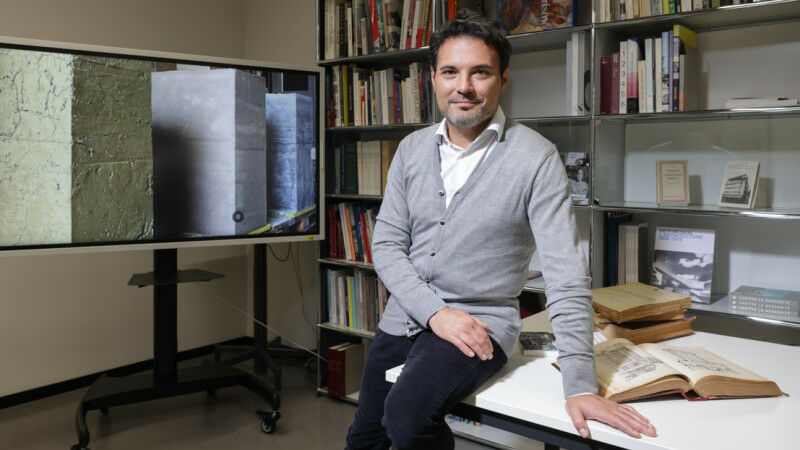
 Salvatore Aprea, between archives and projection of wall prototypes.
Salvatore Aprea, between archives and projection of wall prototypes. EPFL / A. Herzog A team of experts from EPFL, ETH Zurich and a Geneva-based architecture firm has developed a new type of non-reinforced concrete made from stone offcuts. Their method, which reduces the use of carbon-intensive cement-based binders, draws on ancient techniques uncovered in historical archives. Some walls could easily be built without reinforced concrete, a material that accounts for a large share of the construction industry's carbon footprint. In fact, these walls could even be made from unprocessed quarry waste. To see how this might be possible, the research team - consisting of experts from EPFL's Archives of Modern Construction (Acm) research group, the ETH Zurich Chair of Sustainable Construction, and Archiplein - delved into historical archives to unearth forgotten construction methods. They tested various options involving different processes and cement mixtures as part of the Circular Building Industry (CBI) Booster, a program that backs innovative construction-industry initiatives based on circular principles.
TO READ THIS ARTICLE, CREATE YOUR ACCOUNT
And extend your reading, free of charge and with no commitment.
Your Benefits
- Access to all content
- Receive newsmails for news and jobs
- Post ads