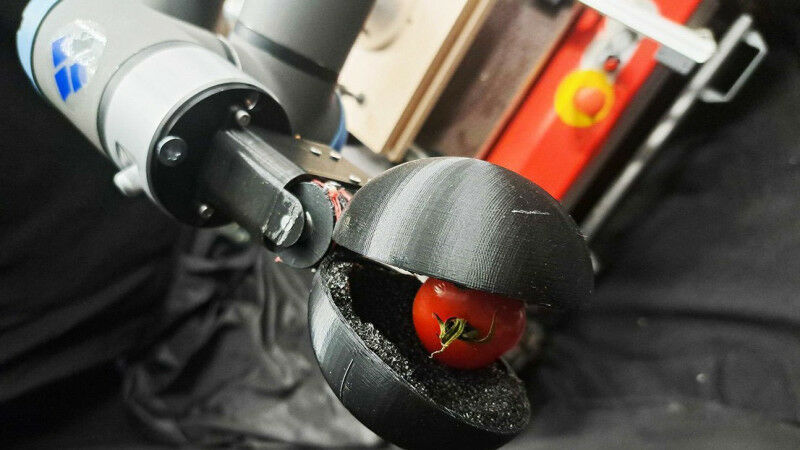
© CREATE Lab/EPFL - Researchers have used Chat-GPT-3 to develop a robotic gripper for harvesting tomatoes, in a first demonstration of the artificial intelligence tool's potential for collaborating with humans on robot design. With their ability to process vast amounts of text data, and to use this information to answer prompts, neural networks known as large language models (LLMs) like Chat-GPT have been making headlines for their potential to change the way we write, learn, and even make art. Now, researchers have applied the technology to a new sphere: robotic design. In a case study published in Nature Machine Intelligence , Josie Hughes, head of the Computational Robot Design & Fabrication Lab in the School of Engineering, EPFL PhD candidate Francesco Stella, and Cosimo Della Santina of TU Delft used Chat-GPT to design a working robotic tomato-harvester. The study provides a framework for humans and LLMs to design such devices collaboratively. Based on their experience, the researchers describe opportunities and risks of applying artificial intelligence (AI) tools to robotics, which they argue "could change the way we design robots, while enriching and simplifying the process." "Even though Chat-GPT is a language model and its code generation is text-based, it provided significant insights and intuition for physical design, and showed great potential as a sounding board to stimulate human creativity," says Hughes. Potential and pitfalls of AI as 'inventor'.
TO READ THIS ARTICLE, CREATE YOUR ACCOUNT
And extend your reading, free of charge and with no commitment.
Your Benefits
- Access to all content
- Receive newsmails for news and jobs
- Post ads


