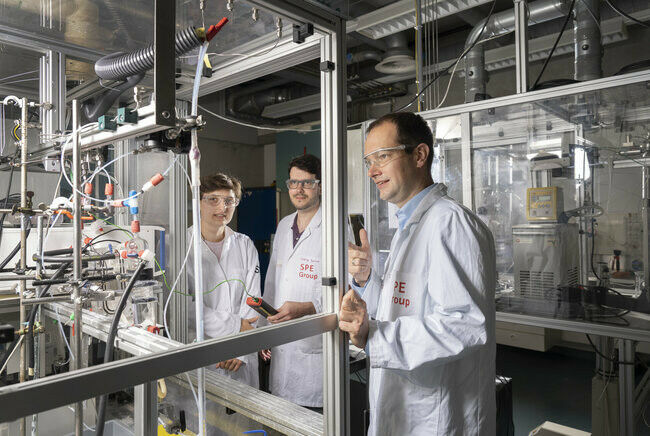
Carlijn Sebregts, Rodrigo Lira Garcia Barros and Thijs de Groot check out the alkaline elektrolyzer test setup at the TU/e. Photo: Vincent van den Hoogen
Carlijn Sebregts, Rodrigo Lira Garcia Barros and Thijs de Groot check out the alkaline elektrolyzer test setup at the TU/e. Photo: Vincent van den Hoogen An article by TU/e researcher Thijs de Groot and his team on the usefulness of a small cathode gap in alkaline electrolyzers appeared in the International Journal of Hydrogen Energy recently. Green hydrogen is a serious contender to become a renewable energy carrier. For example, we could use it to store solar and wind energy during peaks in order to utilize the energy when the sun is no longer shining and the wind is calm. This would require more electrolyzers that can efficiently and flexibly handle fluctuations in power supply. However, the electrolyzers that can already do so use rare and expensive raw materials for their electrodes, such as platinum and iridium, while more affordable alkaline electrolyzers struggle to operate flexibly. This is where a team of TU/e researchers, led by Thijs de Groot (Chemical Engineering & Chemistry), may have now found a solution.
TO READ THIS ARTICLE, CREATE YOUR ACCOUNT
And extend your reading, free of charge and with no commitment.