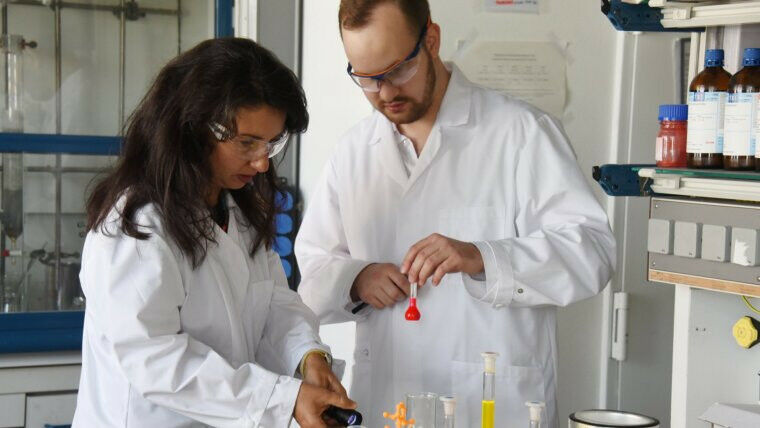
Kalina Peneva and her PhD candidate Konrad Hotzel are investigating functional dyes. Image: Anne Günther (University of Jena)
Kalina Peneva and her PhD candidate Konrad Hotzel are investigating functional dyes. Image: Anne Günther (University of Jena) - For hydrogen to be sustainably produced using sunlight, it's not just an efficient catalyst system that's needed - it must also be economical, readily available, and resource-efficient. A team led by chemist Kalina Peneva from the Institute of Organic Chemistry and Macromolecular Chemistry at the University of Jena has made a step in this direction. In their research, the group developed dyes that are metal-free, simple to produce, and can transfer absorbed light energy to a catalyst to produce hydrogen. Innovative Dye Molecules. "More precisely, these dye molecules, also called photosensitizers, absorb light and convert its energy into a long-lived excited state within the molecule," explains Peneva. She compares this process to fluorescence, as seen in objects or garments that glow brightly under black light.
TO READ THIS ARTICLE, CREATE YOUR ACCOUNT
And extend your reading, free of charge and with no commitment.