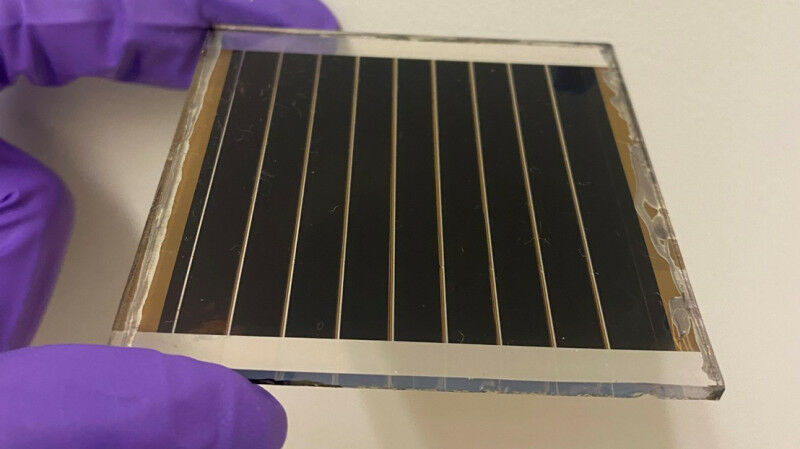
A perovskite solar module with an active area of 22.0 cm2 containing fluorinated aniliniums for interfacial passivation. Credit: Cheng Liu, Northwestern University
A perovskite solar module with an active area of 22.0 cm2 containing fluorinated aniliniums for interfacial passivation. Credit: Cheng Liu, Northwestern University - Researchers have found a way to significantly improve the operational stability of perovskite solar cells at high temperatures, which is necessary for their use in terawatt power grids. Perovskite solar cells (PSCs) have gained attention for their high power-conversion efficiencies and low-cost solution processing. However, ensuring their stability at high temperatures has been a challenge, as the points of contact between their different layers ("interfaces") are susceptible to degradation, leading to energy loss and decreased performance. In a new study, researchers have found that they can minimize PSC degradation at high temperatures by using fluorinated aniliniums, a class of compounds used in pharmaceuticals, agrochemicals, and materials science. The study was led by Michael Grätzel at EPFL, Edward Sargent at the University of Toronto, and Kenneth Graham at the University of Kentucky. It is published in Science .
TO READ THIS ARTICLE, CREATE YOUR ACCOUNT
And extend your reading, free of charge and with no commitment.