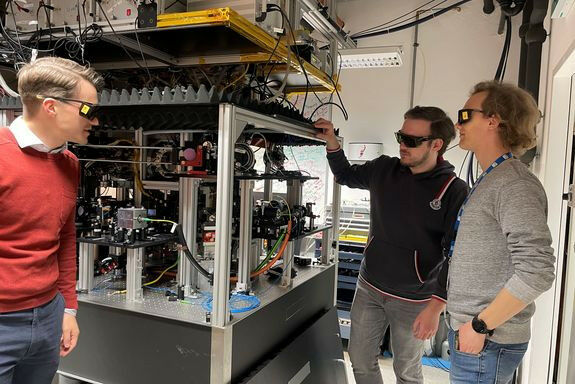
This project required close collaboration between theoretical physics and experimental physics. The two first authors Yevhenii Kuriatnikov (TU Vienna; 2nd from right) and Martino Calzavara (FZ Jülich; 1st from left) discuss final details of the setup with Maximilian Prüfer.
This project required close collaboration between theoretical physics and experimental physics. The two first authors Yevhenii Kuriatnikov (TU Vienna; 2nd from right) and Martino Calzavara (FZ Jülich; 1st from left) discuss final details of the setup with Maximilian Prüfer. In quantum research, tailor-made electromagnetic fields are needed to precisely control particles. The TU Vienna has shown that machine learning is an excellent tool for this purpose . Tiny particles can be manipulated with electromagnetic fields: You can capture them, hold them, or move them to a specific location. However, it is difficult to find out exactly what form these electromagnetic fields should take and how they should be controlled during the experiment. This often requires lengthy series of experiments with numerous measurements.
TO READ THIS ARTICLE, CREATE YOUR ACCOUNT
And extend your reading, free of charge and with no commitment.