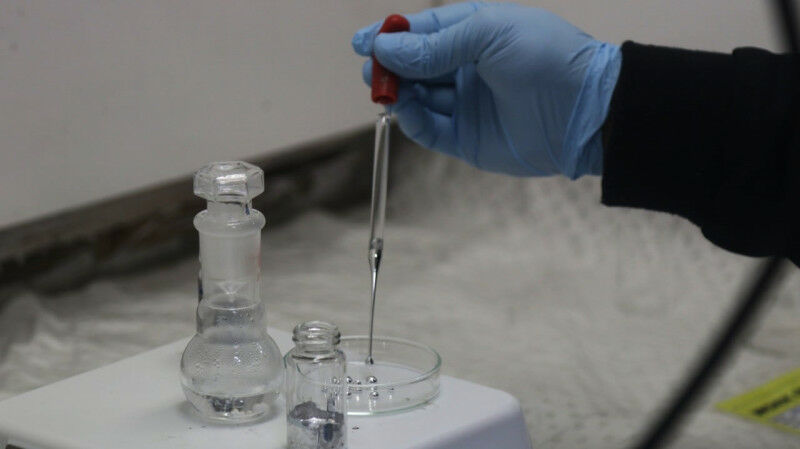
Gallium liquid metal is placed in a petri dish via a syringe. [Credit University of Sydney/Philip Ritchie]
Gallium liquid metal is placed in a petri dish via a syringe. [Credit University of Sydney/Philip Ritchie] Offering the chemical industry an 'unparalleled possibility' for changing the future of chemical processes Liquid metals could be the long-awaited solution to "greening" the chemical industry, according to researchers who tested a new technique they hope can replace energy-intensive chemical engineering processes harking back to the early 20th century. Chemical production accounts for approximately 10-15 percent of total greenhouse gas emissions. More than 10 percent of the world's total energy is also used in chemical factories. Findings published in Nature Nanotechnology today offer a much-needed innovation that moves away from old, energy-intensive catalysts made from solid materials. The research is led by Professor Kourosh Kalantar-Zadeh , Head of the University of Sydney's School of Chemical and Biomolecular Engineering , and Dr Junma Tang, who works jointly at the University of Sydney and UNSW. A catalyst is a substance that makes chemical reactions occur faster and more easily without participating in the reaction. Solid catalysts, typically solid metals or solid compounds of metals, are commonly used in the chemical industry to make plastics, fertilisers, fuels and feedstock.
TO READ THIS ARTICLE, CREATE YOUR ACCOUNT
And extend your reading, free of charge and with no commitment.