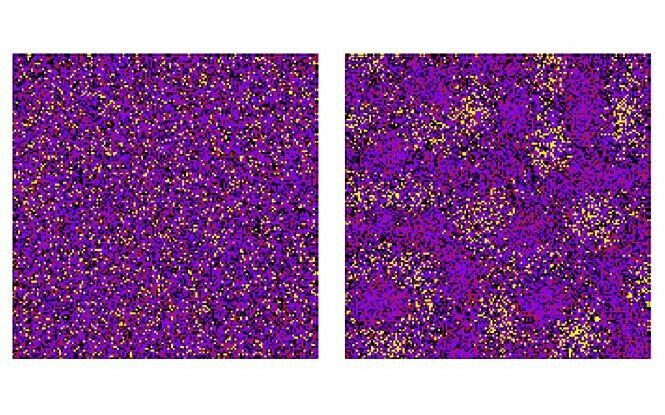
A small composition imbalance (left) results in one component (yellow), which is just slightly more prevalent than the other ones, driving the phase separation in the mixture (right). Photo: Filipe Thewes
A small composition imbalance ( left ) results in one component ( yellow ), which is just slightly more prevalent than the other ones, driving the phase separation in the mixture ( right ). Photo: Filipe Thewes Göttingen researchers use mathematical model to identify new mechanism for control of phase separation The very first life on earth is thought to have developed from -protocells liquid mixtures of many different types of molecules. Researchers from the University of Göttingen have now shown that in such mixtures, small imbalances in the number of molecules of different types can have an unexpected effect. A surprising interplay with the complex pattern of interactions strongly amplifies such imbalances - meaning that a type of molecule that is only slightly in the majority can almost entirely separate out from the others. These fundamental findings point towards a new mechanism that will apply in many complex mixtures. For instance, this would be a way for cells to control the formation of structures by fine-tuning the concentration of different molecules. The research was published in Physical Review Letters .
TO READ THIS ARTICLE, CREATE YOUR ACCOUNT
And extend your reading, free of charge and with no commitment.