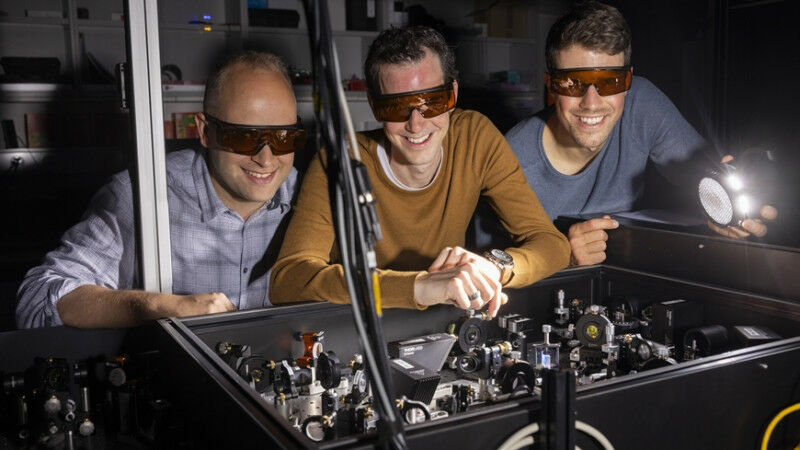
Lysander Huberich (left), team leader Bruno Schuler (middle) and optics specialist Jonas Allerbeck at the THz optics, which generates picosecond-precise excitation pulses. Image: Empa
Lysander Huberich ( left ), team leader Bruno Schuler ( middle ) and optics specialist Jonas Allerbeck at the THz optics, which generates picosecond-precise excitation pulses. Image: Empa Bruno Schuler and his young team are embarking on an ambitious research project: He will selectively generate defects in atomically-thin semiconductor layers and attempt to measure and control their quantum properties with simultaneous picosecond temporal resolution and atomic precision. The resulting insights are expected to establish fundamental knowledge for future quantum computers. The term molybdenum disulfide may sound familiar to some car drivers and mechanics. No wonder: the substance, discovered by US chemist Alfred Sonntag in the 1940s, is still used today as a high-performance lubricant in engines and turbines, but also for bolts and screws. This is due to the special chemical structure of this solid, whose individual material layers are easily displaceable relative to one another. However, molybdenum disulfide (chemically MoS2) not only lubricates well, but it is also possible to exfoliate a single atomic layer of this material or to grow it synthetically on a wafer scale.
TO READ THIS ARTICLE, CREATE YOUR ACCOUNT
And extend your reading, free of charge and with no commitment.