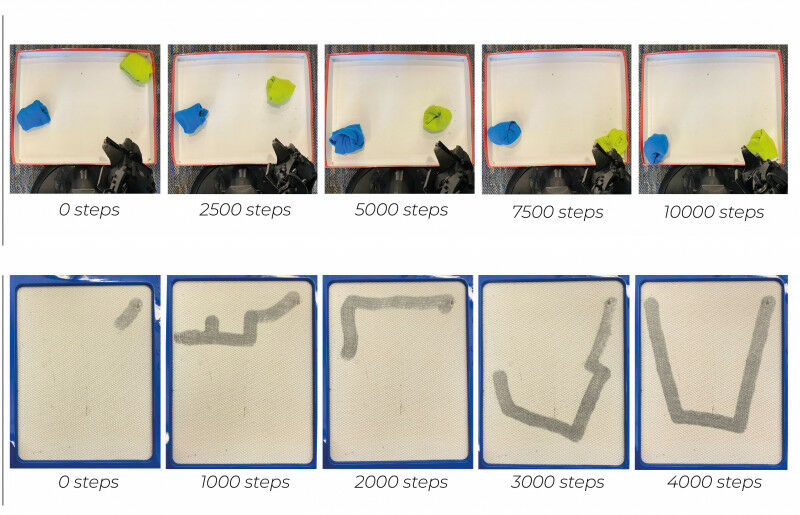
In real-world tests, researchers utilized HuGE to train robotic arms to pick and place objects and to draw the letter ’U.’ They crowdsourced data from 109 nonexpert users in 13 different countries spanning three continents. Credits : Image: Courtesy of the researchers
In real-world tests, researchers utilized HuGE to train robotic arms to pick and place objects and to draw the letter 'U.' They crowdsourced data from 109 nonexpert users in 13 different countries spanning three continents. Credits : Image: Courtesy of the researchers Human Guided Exploration (HuGE) enables AI agents to learn quickly with some help from humans, even if the humans make mistakes. To teach an AI agent a new task, like how to open a kitchen cabinet, researchers often use reinforcement learning - a trial-and-error process where the agent is rewarded for taking actions that get it closer to the goal. In many instances, a human expert must carefully design a reward function, which is an incentive mechanism that gives the agent motivation to explore. The human expert must iteratively update that reward function as the agent explores and tries different actions. This can be time-consuming, inefficient, and difficult to scale up, especially when the task is complex and involves many steps.
TO READ THIS ARTICLE, CREATE YOUR ACCOUNT
And extend your reading, free of charge and with no commitment.