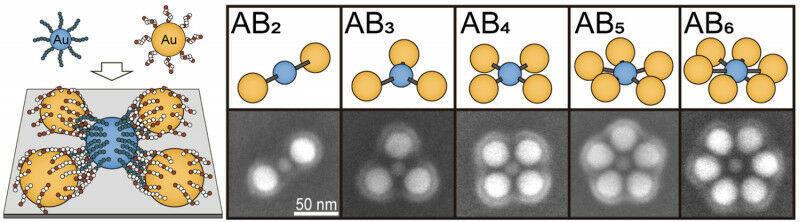
Gold nanoparticles react with the help of customised polymers to form precisely ordered plasmonic molecules. Photo: Cai/Vana
Gold nanoparticles react with the help of customised polymers to form precisely ordered plasmonic molecules. Photo: Cai/Vana Research team at Göttingen University develops plasmonic molecules from nanoparticles In the incredibly small world of molecules, the elementary building blocks - the atoms - join together in a very regular pattern. In contrast, in the macroscopic world with its larger particles, there is much greater disorder when particles connect. A research team at the University of Göttingen has now succeeded in achieving the same precise arrangement of atoms shown in molecules, but using nanometer-sized particles, known as -plasmonic molecules combinations of nanoscale metallic structures that have unique properties. The results were published in Angewandte Chemie International Edition , the journal of the German Chemical Society, which has classified the article as a "very important paper". There is a transition area between molecular and macroscopic levels, an in-between zone called the nanometre range, where there is often a disordered aggregation of particles. Precise arrangement of nanometre-sized structures - at just one billionth of a metre - is one of the major challenges in the ongoing miniaturisation in electronics, optics and medicine.
TO READ THIS ARTICLE, CREATE YOUR ACCOUNT
And extend your reading, free of charge and with no commitment.