Reaching for the unknown dark universe
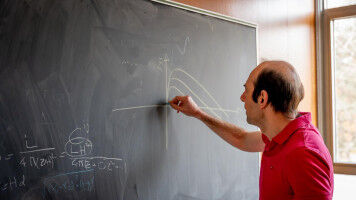
Waterloo Will Percival gives public talk on upcoming Euclid mission By Jon Parsons University Relations Dr. Will Percival is a primary science coordinator for the Euclid space mission, set to launch from Cape Canaveral this July. Percival is the Mike and Ophelia Lazaridis Distinguished Chair in Astrophysics, director of the Waterloo Centre for Astrophysics and a full professor in the Department of Physics and Astronomy. As Percival explains, the Euclid satellite and the mission it will undertake are designed to solve a specific problem in astrophysics and cosmology. Theoretically, astrophysicists know that some 95 per cent of the universe is made up of what they call dark material, which is further split into dark matter (25 per cent) and dark energy (70 per cent). Only 5 per cent is regular material that we interact with day-to-day. But because these dark materials do not interact through light, it is incredibly difficult to find and isolate them or their effects in a laboratory setting. "We see the effects of dark matter and dark energy through astronomy," Percival continues.