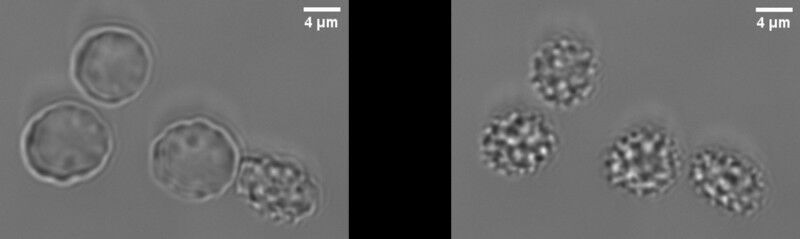
Microscope image of red blood cells with azobenzene in the cell membrane: left, similar to the disc shape (discocyte) under UV light, right, datura shape (echinocyte) under visible light. Photo: Adapted from Höglsperger, F. et al., Nature Communications, DOI: 10.1038/s41467’023 -39032-0; licence CC BY 4.0
Microscope image of red blood cells with azobenzene in the cell membrane: left , similar to the disc shape (discocyte) under UV light, right, datura shape (echinocyte) under visible light. Photo: Adapted from Höglsperger, F. et al. Nature Communications, DOI: 10.1038/s41467'023 -39032-0; licence CC BY 4. Research team with Göttingen University uses light to reversibly change the shape of red blood cells Membranes are crucial to the functioning of living cells: they separate the cells from the environment and protect them; they transport nutrients into the middle of the cell; and they are vital when cells grow together to form tissues, reproduce by division or move around. Researchers from the Universities of Göttingen and Münster have now described for the first time how living cells can be changed reversibly by targeting the cell membrane with light. In their laboratory experiment, red blood cells took on a spiked shape thanks to a built-in "molecular light switch" when illuminated with visible light. When exposed to UV light, they flattened out into their natural disc shape.
TO READ THIS ARTICLE, CREATE YOUR ACCOUNT
And extend your reading, free of charge and with no commitment.