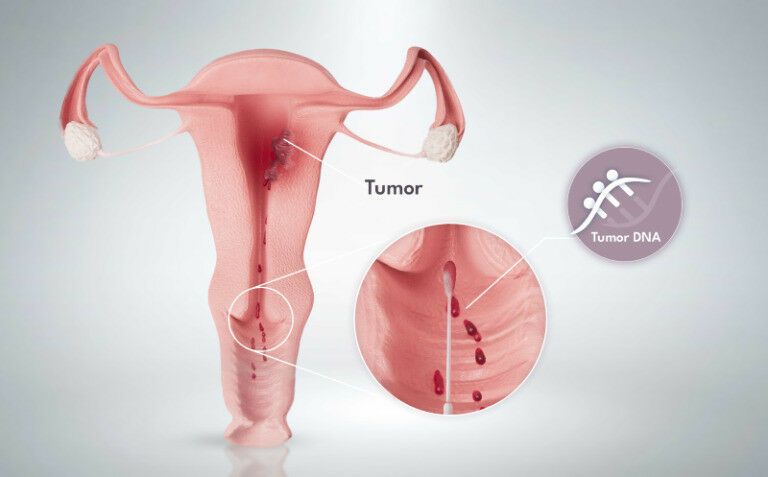
WID-qEC illustration Widschwendter et al.
WID-qEC illustration Widschwendter et al. A new test to detect womb cancer could prevent 87% of women who do not have cancer from needing invasive diagnostic procedures, finds a new study led by researchers at UCL and the University of Innsbruck. The test, called WID-qEC, could simplify and speed up the pathway to a diagnosis of womb cancer or ruling the condition out as a cause of symptoms. The research, published in The Lancet Oncology and funded by gynae cancer research charity The Eve Appeal, The European Research Council and Land Tirol, shows that the WID-qEC test outperforms imaging at ruling out womb cancer and could save nearly 90% of periand post-menopausal women from needing invasive surgical biopsies when getting abnormal vaginal bleeding symptoms checked. This could save thousands of women each year from potentially painful surgical biopsies and increased anxiety while waiting for answers. YouTube Widget Placeholder Professor Martin Widschwendter (UCL EGA Institute for Women's Health and University of Innsbruck), said: "One of the most important principles of modern preventative medicine is 'less is more'. "The WID-qEC test is an ideal example of this.
TO READ THIS ARTICLE, CREATE YOUR ACCOUNT
And extend your reading, free of charge and with no commitment.