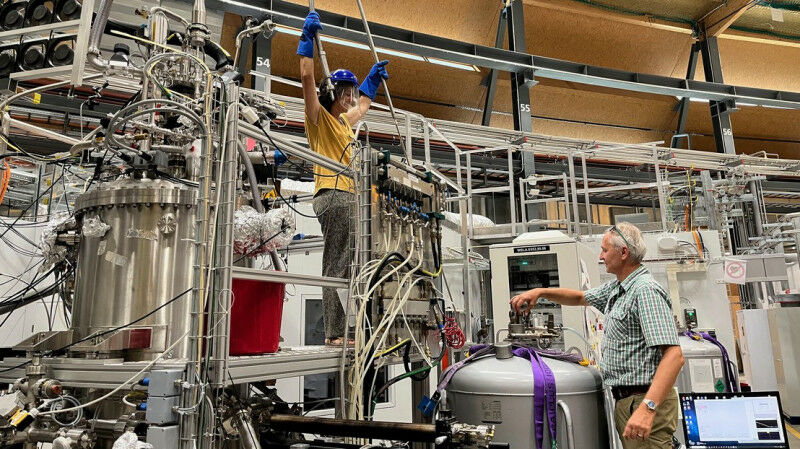
Cinthia Piamonteze and Juraj Krempasky working on an experiment of the study at the Paul Scherrer Institut. Credit: Dominik Kriegner (FZU)
Cinthia Piamonteze and Juraj Krempasky working on an experiment of the study at the Paul Scherrer Institut. Credit: Dominik Kriegner (FZU) - A research collaboration has uncovered a surprising magnetic property of an exotic material that might lead to computers that need less than one-millionth of the energy required to switch a single bit. The world of materials science is constantly discovering or fabricating materials with exotic properties. Among them are the multiferroics, a unique class of materials that can be both magnetized and polarized at the same time, which means that they are sensitive to both magnetic and electric fields. Having both these properties in a single material has made multiferroics very interesting for research and commercial purposes with potential applications from advanced electronics to next-generation memory storage. By understanding and harnessing the properties of multiferroics, researchers aim to develop more efficient, compact, and even energy-saving technologies. Now, an international research collaboration has uncovered some fascinating properties for the multiferroic Manganese-doped Germanium Telluride (Mn-doped GeTe); the -doped- part of the name simply means that a small amount of manganese (Mn) atoms has been introduced into the germanium telluride (GeTe) crystal structure to modify its properties.
TO READ THIS ARTICLE, CREATE YOUR ACCOUNT
And extend your reading, free of charge and with no commitment.