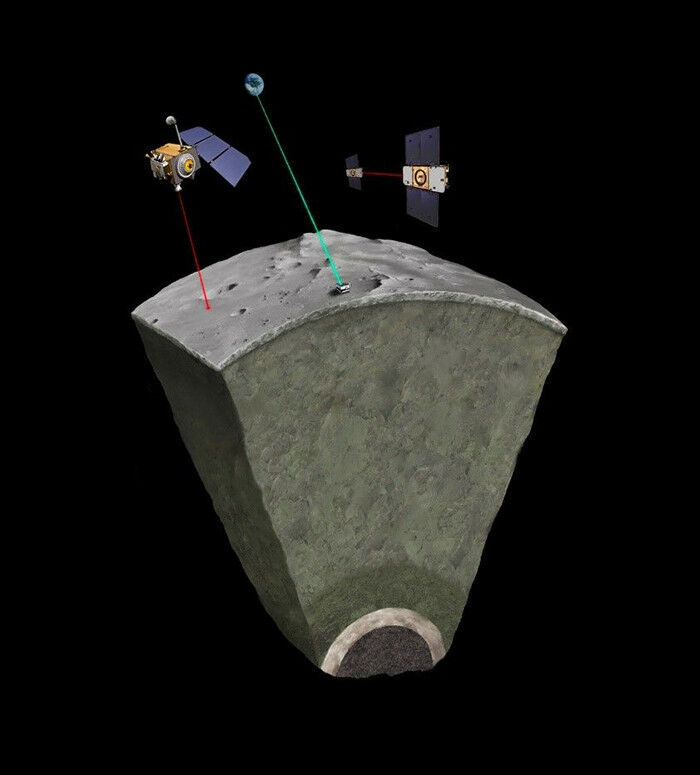
 Artist’s impression of the lunar interior. From the surface down to the centre: a thin crust, a very thick mantle, a low-viscosity zone at the core-mantle boundary, a fluid outer core, and a solid inner core.
Artist's impression of the lunar interior. From the surface down to the centre: a thin crust, a very thick mantle, a low-viscosity zone at the core-mantle boundary, a fluid outer core, and a solid inner core. Géoazur/Nicolas Sarter - By combining various techniques, scientists have successfully revealed the internal structure of the Moon. Their findings confirm that the Moon has a solid core, like the Earth. They also confirm the 'mantle overturn' and explain the presence of iron-rich elements at the surface of the Moon. Fifty years after Apollo 11 paved the way for the first surveys of the Moon, a team of scientists from CNRS, Université Côte d'Azur, the Côte d'Azur Observatory, Sorbonne Université and the Paris Observatory-PSL has shed light on part of its internal structure that had until now remained a mystery: the Moon has a solid core, like the Earth. In addition to this discovery, they also present evidence that explains the presence of iron-rich materials in the lunar crust.
TO READ THIS ARTICLE, CREATE YOUR ACCOUNT
And extend your reading, free of charge and with no commitment.
Your Benefits
- Access to all content
- Receive newsmails for news and jobs
- Post ads