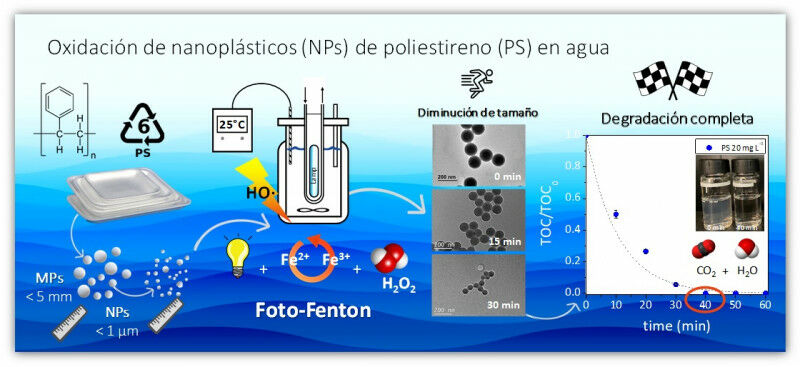
Graphical abstract of the article published in JECE (doi: 10.1016/j.jece.2023.110755).
Graphical abstract of the article published in JECE (doi: 10.1016/j.jece. Researchers at the Autonomous University of Madrid (UAM) have developed a process based on the photo-Fenton method that allows the efficient degradation of polystyrene nanoplastics in water. This breakthrough could be key in the fight against plastic pollution, especially in wastewater treatment plants (WWTP). A team of environmentalists, chemists and chemical engineers from the Universidad Autónoma de Madrid (UAM) and the Universidad Nacional de Mar del Plata (Argentina) has investigated the application of the photo-Fenton treatment method to degrade polystyrene nanoplastics in water. This method combines a light source (UV-Vis radiation) with low concentrations of iron (as a homogeneous catalyst) to activate the decomposition of hydrogen peroxide (H2O2) into highly oxidizing species. These species can degrade various persistent pollutants into harmless molecules, such as carbon dioxide and water, operating under ambient conditions. The results, published in the Journal of Environmental Chemical Engineering , reveal that the photo-Fenton process achieves complete and rapid degradation of polystyrene nanoplastics in water, significantly exceeding the removal levels of other photocatalytic processes mentioned in previous studies.
TO READ THIS ARTICLE, CREATE YOUR ACCOUNT
And extend your reading, free of charge and with no commitment.