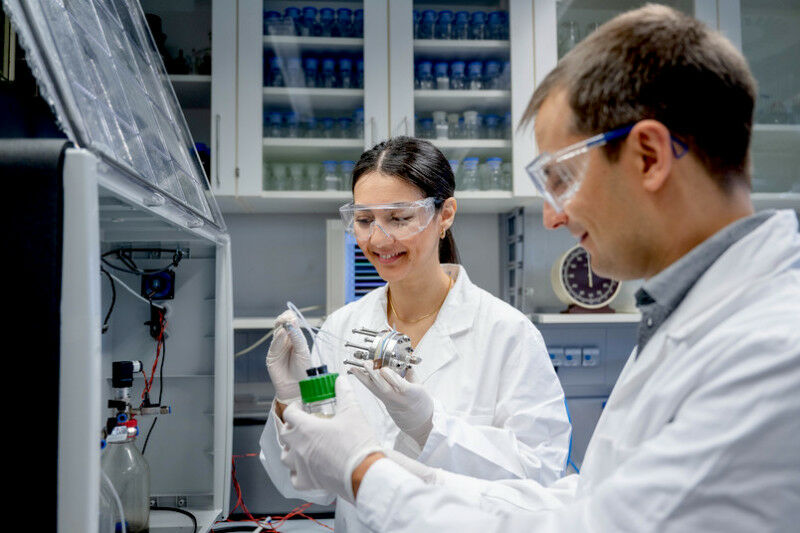
 Ramineh Rad and Tito Gehring are investigating how microorganisms in sewage treatment plants can contribute to the energy transition.
Ramineh Rad and Tito Gehring are investigating how microorganisms in sewage treatment plants can contribute to the energy transition. RUB, Marquard - By implementing an innovative technology, any wastewater treatment plant would be able to produce methane from carbon dioxide in an environmentally friendly way. If some microorganisms present in wastewater treatment plants are additionally supplied with hydrogen and carbon dioxide, they produce pure methane. Heating systems and vehicles running on natural gas can make use of this methane without the need of any technical modifications. Through the combination of the expertise of the research groups from Dr. Tito Gehring / Professor Marc Wichern and Professor Ulf-Peter Apfel, both at Ruhr University Bochum, a technical add-on module was developed that can, in principle, turn any wastewater treatment plant into a CO
2 sink and decentralized methane production plant in an environmentally friendly way. They published their findings in the journal Cell Reports Physical Science of 16 August 2023 . Bad reputation, valuable properties.
TO READ THIS ARTICLE, CREATE YOUR ACCOUNT
And extend your reading, free of charge and with no commitment.
Your Benefits
- Access to all content
- Receive newsmails for news and jobs
- Post ads