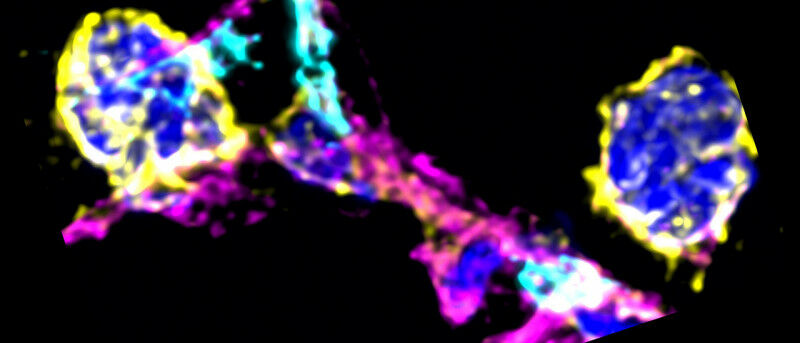
The fluorescence micrograph on the right shows the interaction of platelets (cyan) with inflammatory cells (yellow) in lung tissue, as well as a migrated inflammatory cell outside the blood vessel (magenta) within the alveoli. (Image: Rudolf Virchow Center - Center for Integrative and Translational Bioimaging).
The fluorescence micrograph on the right shows the interaction of platelets ( cyan ) with inflammatory cells ( yellow ) in lung tissue, as well as a migrated inflammatory cell outside the blood vessel ( magenta ) within the alveoli. (Image: Rudolf Virchow Center - Center for Integrative and Translational Bioimaging). Acute lung failure is life-threatening - especially if it is accompanied by an excessive immune response. Researchers at the University Medical Center Würzburg have now discovered how this reaction can be suppressed . One in ten people receiving intensive care develops acute respiratory distress syndrome (ARDS). Most of these respiratory distress syndromes, of which the mild form is also known as ALI (Acute Lung Injury), are caused by pneumonia, but blood poisoning, external injuries, blood cancer and autoimmune diseases or so-called foreign body aspiration can also impair lung function in a life-threatening manner. Common to all causes are inflammatory processes that damage lung tissue.
TO READ THIS ARTICLE, CREATE YOUR ACCOUNT
And extend your reading, free of charge and with no commitment.