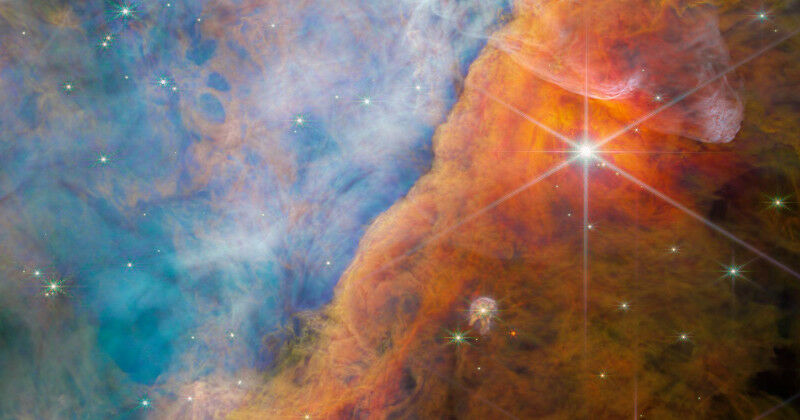
A nebula made of many layers of cloudy, colourful material. The top-left side of the image is brightly lit, filled with wispy, thin material in pale shades of pink and blue. A thick bar of denser, cloudier material crosses diagonally at the bottom right. It begins as orange and grows darker and sparser down to the corner. Two very bright stars, with very long diffraction spikes, lie in this sparse area. Credit: ESA/Webb, NASA, CSA, M. Zamani (ESA/Webb), the PDRs4All ERS Team
A nebula made of many layers of cloudy, colourful material. The top- left side of the image is brightly lit, filled with wispy, thin material in pale shades of pink and blue. A thick bar of denser, cloudier material crosses diagonally at the bottom right. It begins as orange and grows darker and sparser down to the corner. Two very bright stars, with very long diffraction spikes, lie in this sparse area. Credit: ESA/Webb, NASA, CSA, M. Zamani (ESA/Webb), the PDRs4All ERS Team An international team of scientists have used data collected by the NASA / / James Webb Space Telescope to detect for the first time ever a molecule known as methyl cation (CH3+), located in the protoplanetary disc surrounding a young star. They accomplished this feat with interdisciplinary expert analysis, including key input from laboratory spectroscopists.
TO READ THIS ARTICLE, CREATE YOUR ACCOUNT
And extend your reading, free of charge and with no commitment.