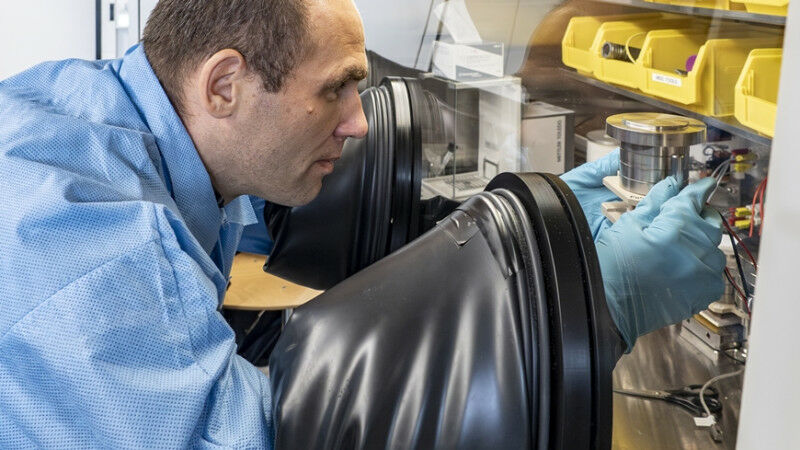
Under pressure: Kostiantyn Kravchyk studies whether the unwanted growth of dendrites can be reduced with pressure. The work on the novel batteries is carried out in a protective atmosphere. Image: Empa
Under pressure: Kostiantyn Kravchyk studies whether the unwanted growth of dendrites can be reduced with pressure. The work on the novel batteries is carried out in a protective atmosphere. Image: Empa The Empa research group led by Maksym Kovalenko is researching innovative materials for the batteries of tomorrow. Whether it's fast-charging electric cars or low-cost stationary storage, there's a promising material or a novel manufacturing process for every application. What are the hallmarks of a good battery? Is it its capacity? How fast it charges? Or its price? The answer depends on where the battery is used, says Empa researcher Kostiantyn Kravchyk. In the Functional Inorganic Materials Group, led by Maksym Kovalenko and part of Empa's Laboratory for Thin Films and Photovoltaics, the scientist is developing new materials to make tomorrow's batteries more powerful and faster - or more cost-effective. Two areas of application for rechargeable batteries are crucial for the transition to renewable energy.
TO READ THIS ARTICLE, CREATE YOUR ACCOUNT
And extend your reading, free of charge and with no commitment.