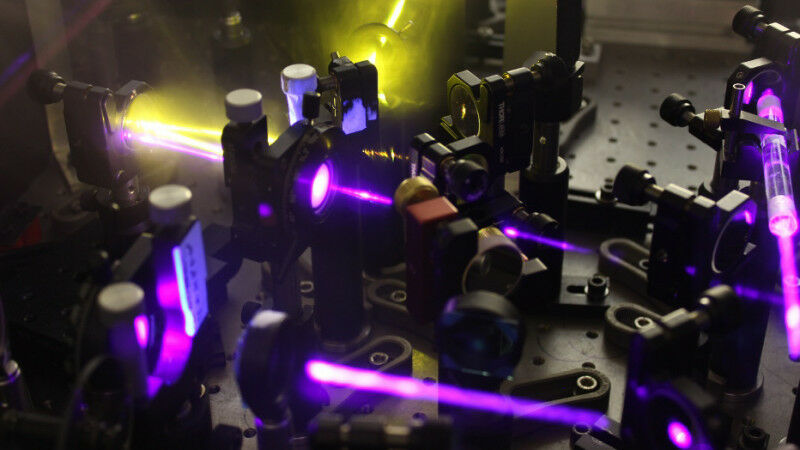
Aufbauten für die ultraschnelle Laserspektroskopie neuartiger Halbleiter.
Aufbauten für die ultraschnelle Laserspektroskopie neuartiger Halbleiter. A research team under the direction of Felix Deschler at Heidelberg University's Institute for Physical Chemistry has developed a semiconductor that efficiently generates light and simultaneously gives that light a certain spin. According to the researchers, the so-called chiral perovskite material has great technological potential that can be used for applications in optoelectronics, telecommunications, and information processing. Generating bright, circularly polarised light has long been a goal of materials science. It is considered exceedingly difficult to achieve a distinct chirality - which describes the rotation of light in a specific direction - as well as high photoluminescence quantum efficiency (PLQE). The PLQE value expresses the ability of a material to emit light. Inorganic semiconductors are able to emit high brightness but usually exhibit low light polarisation.
TO READ THIS ARTICLE, CREATE YOUR ACCOUNT
And extend your reading, free of charge and with no commitment.