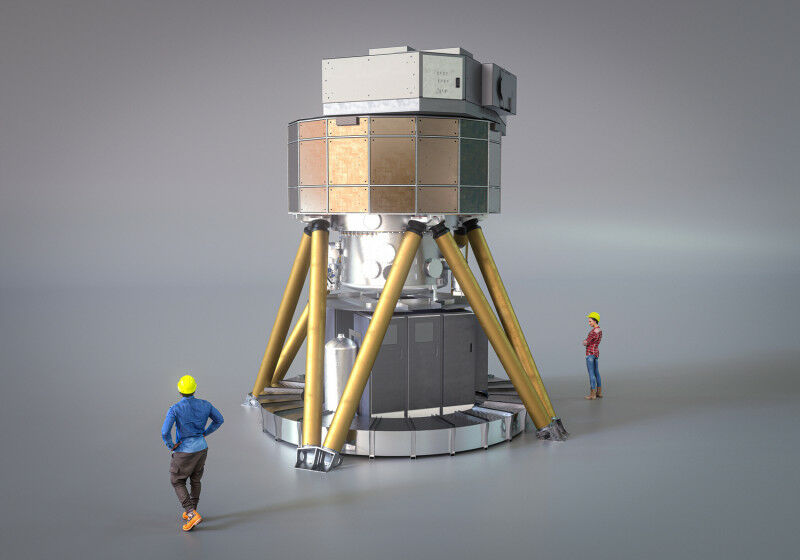
University of Göttingen involved in the development of a new high-resolution astro camera
The European Southern Observatory (ESO) has taken an important step towards its 40-meter class telescope, the Extremely Large Telescope (ELT), which is currently under construction: the high-resolution camera, Multi-AO Imaging Camera for Deep Observations (MICADO), has passed the final design review. The powerful camera will enable astronomers to capture images of the universe at unprecedented depths. The MICADO consortium, an international team including the Institute of Astrophysics and Geophysics at the University of Göttingen, can now concentrate on manufacturing and testing the instrument.
When developing the instrument, the aim was to achieve high sensitivity, high resolution, astrometric accuracy and coverage of a wide wavelength range. The camera system is installed in such a way that the light from the telescope can be transmitted to the cryostat via the adaptive optics system, which corrects for atmospheric blurring. Here, the optics and detectors are cooled down to 200 degrees Celsius below the ambient temperature so that they can work effectively in the near infrared range without interference from background radiation.
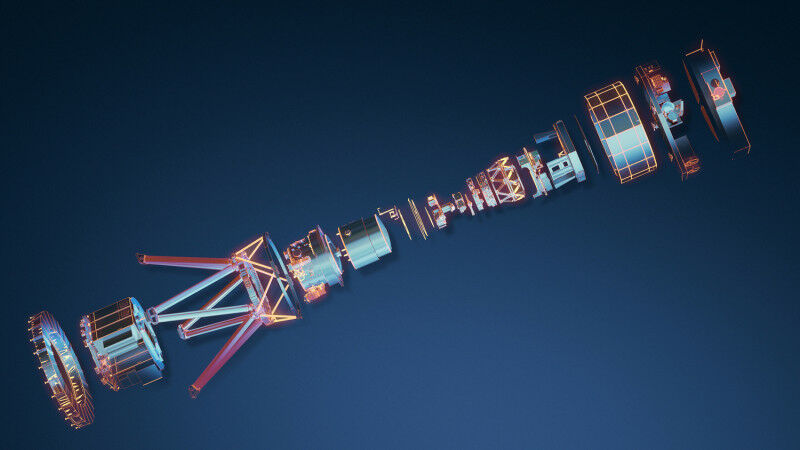
Once the ELT is operational, this camera will provide high-resolution images of the universe, revealing the detailed structures and formation mechanisms of distant galaxies. In addition, astronomers will be able to study individual stars and star systems in nearby galaxies as well as planets and their formation outside our solar system. They will also be able to study environments where gravitational forces are extremely strong, for example near the black hole at the center of the Milky Way. ESO plans to put the 40-meter telescope with this camera into operation in the course of this decade.