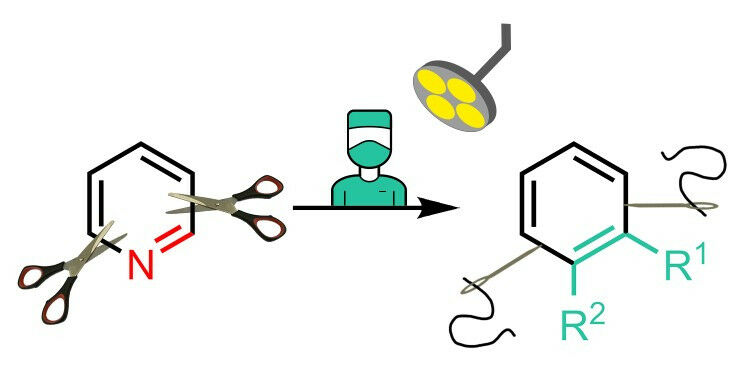
 The skeletal editing of pyridines is a useful technique in organic synthesis, and one which is promising as regards the development of new drugs. The process resembles an ’operation’ on a molecule, surgically removing one fragment and skilfully attaching another one.
Chemists at the University of Münster realised -chemical surgery- on ring-shaped compounds / Results published in -Nature Chemistry-. The skeletal editing of pyridines is a useful technique in organic synthesis, and one which is promising as regards the development of new drugs. The process resembles an 'operation' on a molecule, surgically removing one fragment and skilfully attaching another one. University of Münster - Studer working group In the field of chemistry, so-called skeletal editing is seen as a method suitable for changing ring-shaped structures precisely by swapping individual atoms. A team of researchers led by Prof. Armido Studer from the Institute of Organic Chemistry at the University of Münster has now introduced a new strategy for converting carbon-nitrogen atom pairs in pyridines - a ring-shaped compound frequently used as a synthesis building block - into carbon-carbon atom pairs. The method has potential in the quest for new drugs and materials which are often based on such molecule rings. While the ring structure remains intact in the so-called peripheral functionalisation of rings - which involves for example the attachment of groups of atoms - skeletal editing requires the cleavage of robust bonds between carbon atoms or between a carbon atom and another atom within the ring.
TO READ THIS ARTICLE, CREATE YOUR ACCOUNT
And extend your reading, free of charge and with no commitment.
Your Benefits
- Access to all content
- Receive newsmails for news and jobs
- Post ads