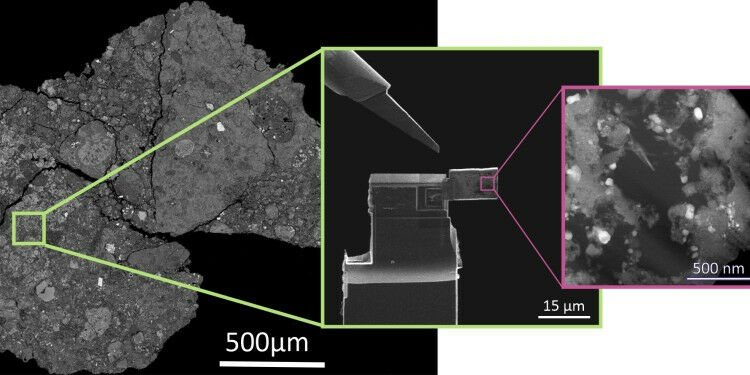
 Using a nanomanipulator and an ultra-fine ion beam, a tiny lamella, about five by ten micrometres in size and only one hundred nanometres thin, is cut out of the meteorite and attached to a sample bar. The scientists can then analyze the organic particles in this lamella under an electron microscope (right).
For the first time without any chemical treatment, a research team analyses extraterrestrial amino acids and other organic compounds in an English meteorite fall. Using a nanomanipulator and an ultra-fine ion beam, a tiny lamella, about five by ten micrometres in size and only one hundred nanometres thin, is cut out of the meteorite and attached to a sample bar. The scientists can then analyze the organic particles in this lamella under an electron microscope ( right ). SuperSTEM Laboratory, Daresbury, UK Meteorites are fragments of asteroids which find their way to Earth as shooting stars. These cosmic sediments have frozen the primordial soup from which our solar system emerged - preserving it just like a time capsule. These rocks help researchers to get to the bottom of the origins of matter and of life on Earth. Working together with British colleagues, Dr. Christian Vollmer from the Institute of Mineralogy at Münster University has examined one of these time capsules, and a very special one - the Winchcombe meteorite.
TO READ THIS ARTICLE, CREATE YOUR ACCOUNT
And extend your reading, free of charge and with no commitment.
Your Benefits
- Access to all content
- Receive newsmails for news and jobs
- Post ads