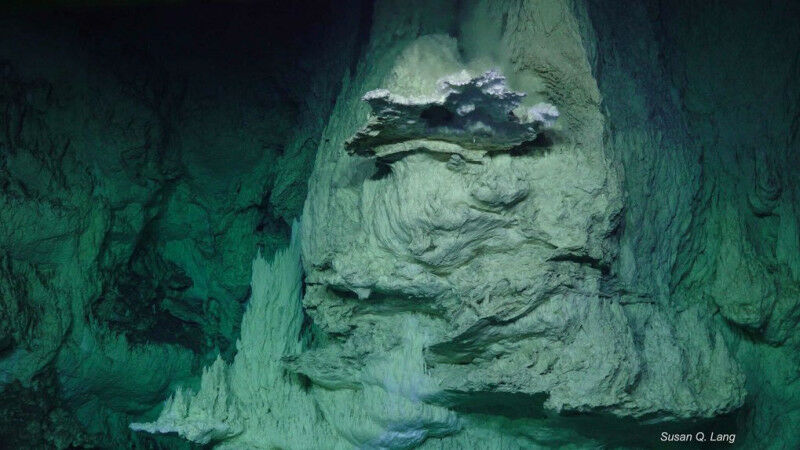
 Sulis formation in the Lost City hydrothermal field, an alkaline hydrothermal vent that produces hydrogen.
Researchers gain new insights into how the first cells on Earth were able to use hydrogen gas as an energy source. Sulis formation in the Lost City hydrothermal field, an alkaline hydrothermal vent that produces hydrogen. Courtesy of Susan Lang, U. of South Carolina /NSF/ROV Jason 2018 Woods Hole Oceanographic Institution) - Hydrogen gas (H
2) is seen as a key to sustainable energy for the future. Yet it is an ancient form of energy. Even the very first cells on earth lived on H
2, which was produced in hydrothermal vents. Now a team of researchers led by William F. Martin from Heinrich Heine University Düsseldorf and Martina Preiner from the Max Planck Institute for Terrestrial Microbiology in Marburg, supported by researchers in Germany and Asia, has provided new insights into how the first cells on Earth came to harness H
2 as an energy source. Hydrogen gas is clean fuel.
TO READ THIS ARTICLE, CREATE YOUR ACCOUNT
And extend your reading, free of charge and with no commitment.
Your Benefits
- Access to all content
- Receive newsmails for news and jobs
- Post ads