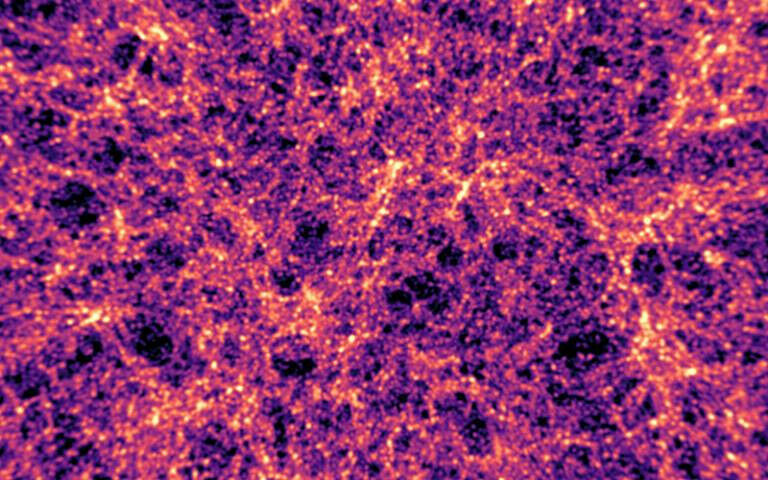
simulated universe map
simulated universe map A UCL-led research team has used artificial intelligence (AI) techniques to infer the influence and properties of dark energy more precisely from a map of dark and visible matter in the Universe covering the last seven billion years. The study, carried out by the Dark Energy Survey collaboration, doubled the precision at which key characteristics of the Universe, including the overall density of dark energy, could be inferred from the map. This increased precision allows researchers to rule out models of the Universe that might previously have been conceivable. Dark energy is the mysterious force that is accelerating the Universe's expansion and is thought to make up about 70% of the content of the Universe (with dark matter, invisible stuff whose gravity pulls galaxies, making up 25%, and normal matter just 5%). Lead author Dr Niall Jeffrey (UCL Physics & Astronomy) said: "Using AI to learn from computer-simulated universes, we increased the precision of our estimates of key properties of the Universe by a factor of two. "To achieve this improvement without these novel techniques, we would need four times the amount of data. This would be equivalent to mapping another 300 million galaxies." Co-author Dr Lorne Whiteway (UCL Physics & Astronomy) said: "Our findings are in line with the current best prediction of dark energy as a 'cosmological constant' whose value does not vary in space or time.
TO READ THIS ARTICLE, CREATE YOUR ACCOUNT
And extend your reading, free of charge and with no commitment.