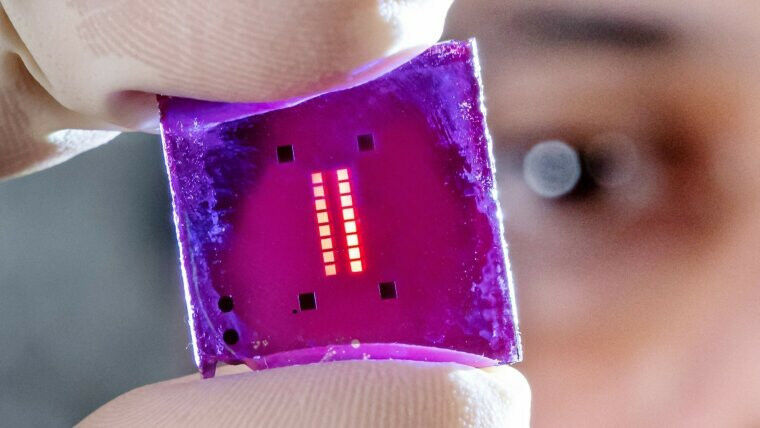
Dr Purushottam Poudel took part in developing a photo-tunable polymer meta surface. Image: Jens Meyer (University of Jena)
Dr Purushottam Poudel took part in developing a photo-tunable polymer meta surface. Image: Jens Meyer (University of Jena) Felix H. Schacher, Dr Purushottam Poudel, Dr Sarah Walden & Isabelle Staude (l.t.r. Combining Two Established Systems to Create Something New. "Both meta-surfaces and light-switchable polymers have been known in principle for decades," explains Sarah Walden from the Institute of Solid State Physics, who now leads a research group in Australia. She adds, "but we are the first to combine both in this form to develop new components for optical applications." Meta-surfaces are nanostructured thin layers whose characteristic structural sizes are smaller than the wavelength of light. This allows the properties of light and its propagation to be specifically influenced, enabling a variety of optical functions that would otherwise be performed by lenses, polarizers, or gratings. On the other hand, switchable polymers are plastics whose properties - such as the light refraction index - can change between different states.
TO READ THIS ARTICLE, CREATE YOUR ACCOUNT
And extend your reading, free of charge and with no commitment.