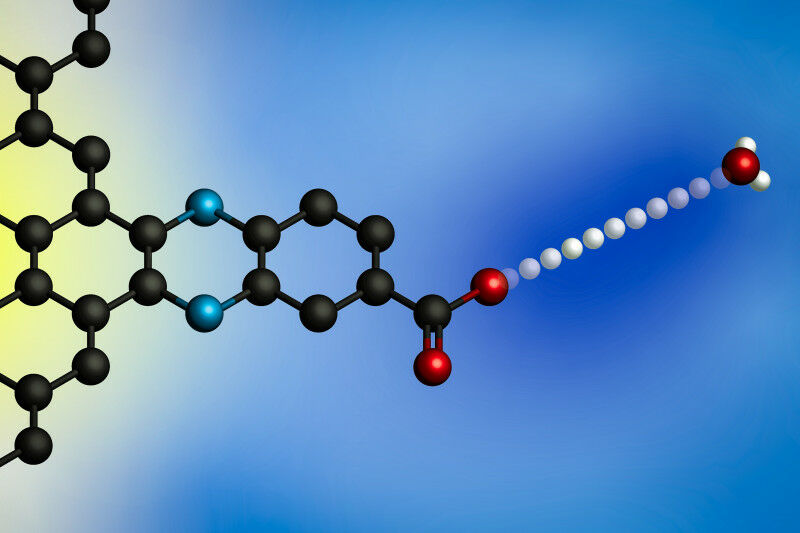
Applying an electric potential causes a proton to transfer from a hydronium ion (at right) to an electrode’s surface. Using electrodes with molecularly defined proton binding sites, MIT researchers developed a general model for these interfacial proton-coupled electron transfer reactions. Credits : Image: Courtesy of the researchers
Applying an electric potential causes a proton to transfer from a hydronium ion (at right) to an electrode's surface. Using electrodes with molecularly defined proton binding sites, MIT researchers developed a general model for these interfacial proton-coupled electron transfer reactions. Credits : Image: Courtesy of the researchers New insights into how proton-coupled electron transfers occur at an electrode could help researchers design more efficient fuel cells and electrolyzers. A key chemical reaction - in which the movement of protons between the surface of an electrode and an electrolyte drives an electric current - is a critical step in many energy technologies, including fuel cells and the electrolyzers used to produce hydrogen gas. For the first time, MIT chemists have mapped out in detail how these proton-coupled electron transfers happen at an electrode surface. Their results could help researchers design more efficient fuel cells, batteries, or other energy technologies. "Our advance in this paper was studying and understanding the nature of how these electrons and protons couple at a surface site, which is relevant for catalytic reactions that are important in the context of energy conversion devices or catalytic reactions," says Yogesh Surendranath, a professor of chemistry and chemical engineering at MIT and the senior author of the study.
TO READ THIS ARTICLE, CREATE YOUR ACCOUNT
And extend your reading, free of charge and with no commitment.