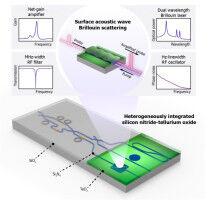
Illustration showing light exciting electrons in two molecules of the organic semiconductor known as buckminsterfullerene. The newly formed exciton (shown by the bright dot) is first distributed over two molecules before it settles on one molecule (shown on the right in the picture). Photo: Andreas Windischbacher
Illustration showing light exciting electrons in two molecules of the organic semiconductor known as buckminsterfullerene. The newly formed exciton (shown by the bright dot) is first distributed over two molecules before it settles on one molecule (shown on the right in the picture). Photo: Andreas Windischbacher Research team led by Göttingen University make extremely fast, precise images for first time. From solar panels on our roofs to the new OLED TV screens, many everyday electronic devices simply wouldn't work without the interaction between light and the materials that make up semiconductors. A new category of semiconductors is based on organic molecules, which largely consist of carbon, such as buckminsterfullerene. The way organic semiconductors work is largely determined by their behaviour in the first few moments after light excites electrons, forming -excitons- in the material. Researchers from the Universities of Göttingen, Graz, Kaiserslautern-Landau and Grenoble-Alpes have now, for the first time, made very fast and very precise images of these excitons - in fact, accurate to one quadrillionth of a second (0.000,000,000,000,001s) and one billionth of a metre (0.000,000,001m).
TO READ THIS ARTICLE, CREATE YOUR ACCOUNT
And extend your reading, free of charge and with no commitment.