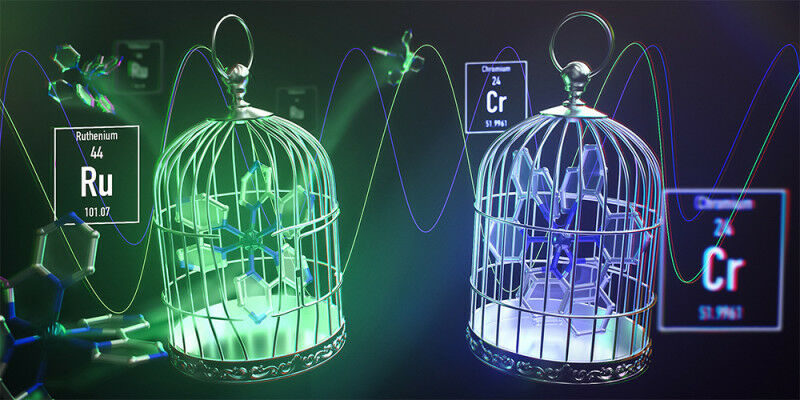
Radicals generated by light can only unfold their reactivity as soon as they break out of a kind of ’cage’ that the solvent forms around them. Researchers in Basel show how to make this ’cage escape’ more successful and how it leads to more efficient photochemistry. (Illustration: University of Basel, Jo Richers)
Radicals generated by light can only unfold their reactivity as soon as they break out of a kind of 'cage' that the solvent forms around them. Researchers in Basel show how to make this 'cage escape' more successful and how it leads to more efficient photochemistry. (Illustration: University of Basel, Jo Richers) Anyone who wants to produce medication, plastics or fertilizer using conventional methods needs heat for chemical reactions - but not so with photochemistry, where light provides the energy. The process to achieve the desired product also often takes fewer intermediate steps. Researchers from the University of Basel are now going one step further and are demonstrating how the energy efficiency of photochemical reactions can be increased tenfold. More sustainable and cost-effective applications are now tantalizingly close. Industrial chemical reactions usually occur in several stages across various interim products.
TO READ THIS ARTICLE, CREATE YOUR ACCOUNT
And extend your reading, free of charge and with no commitment.