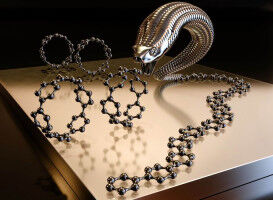
With just a little electricity, MIT researchers boost common catalytic reactions
Applying a small voltage to a catalyst can increase the rates of reactions used in petrochemical processing, pharmaceutical manufacture, and many other processes. A simple technique that uses small amounts of energy could boost the efficiency of some key chemical processing reactions, by up to a factor of 100,000, MIT researchers report. These reactions are at the heart of petrochemical processing, pharmaceutical manufacturing, and many other industrial chemical processes. The surprising findings are reported today in the journal Science , in a paper by MIT graduate student Karl Westendorff, professors Yogesh Surendranath and Yuriy Roman-Leshkov, and two others. "The results are really striking," says Surendranath, a professor of chemistry and chemical engineering. Rate increases of that magnitude have been seen before but in a different class of catalytic reactions known as redox half-reactions, which involve the gain or loss of an electron. The dramatically increased rates reported in the new study "have never been observed for reactions that don't involve oxidation or reduction," he says.