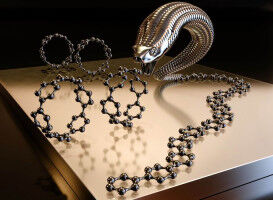
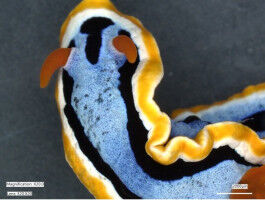
The marine bryozoan Securiflustra securifrons with representative natural product isolates securine A, securamine B, and securamine I. (Digital art by Vaani Gupta)
The marine bryozoan Securiflustra securifrons with representative natural product isolates securine A, securamine B, and securamine I. (Digital art by Vaani Gupta) - Yale researchers have developed a novel approach to synthesize a highly complex group of molecules found in marine invertebrates. Nearly 30 years ago, scientists discovered a unique class of anticancer molecules in a family of bryozoans, a phylum of marine invertebrates found in tropical waters. The chemical structures of these molecules, which consist of a dense, highly complex knot of oxidized rings and nitrogen atoms, has attracted the interest of organic chemists worldwide, who aimed to recreate these structures from scratch in the laboratory. However, despite considerable effort, it has remained an elusive task. Until now, that is. A team of Yale chemists, writing in the journal Science , has succeeded in synthesizing eight of the compounds for the first time using an approach that combines inventive chemical strategy with the latest technology in small molecule structure determination. " These molecules have been an outstanding challenge in the field of synthetic chemistry," said Seth Herzon, the Milton Harris '29 Ph.D.
TO READ THIS ARTICLE, CREATE YOUR ACCOUNT
And extend your reading, free of charge and with no commitment.