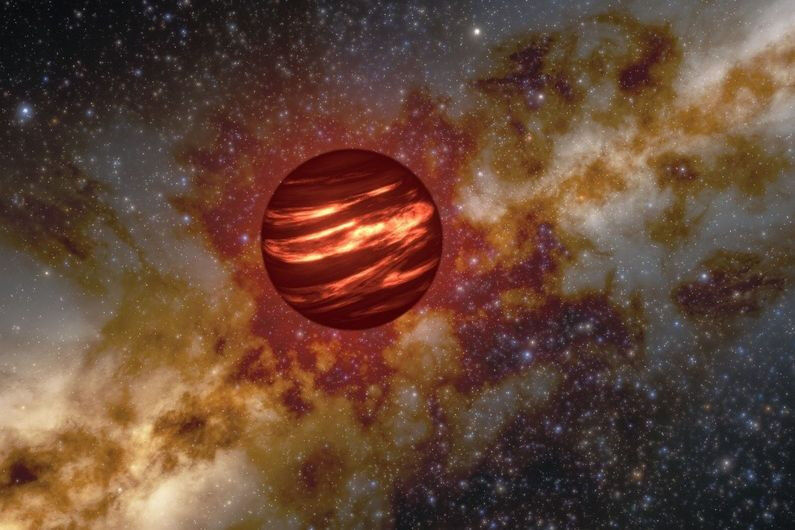
Silane is detected in the atmosphere of a brown dwarf, a celestial body halfway between a star and a planet, an international team of astronomers finds.
Several brown dwarfs - celestial objects whose mass lies somewhere between that of stars and planets - are being studied closely with the James Webb Space Telescope, and in one of them, a previously undetected molecule has now come to light.
It’s called silane (SiHâ‚„), and an international team of astronomers found it on a brown dwarf nicknamed "The Accident." Their remarkable discovery was published in late August in the journal Nature.
We asked Université de Montréal adjunct professor Jonathan Gagné, a member of UdeM’s Trottier Institute for Research on Exoplanets (IREx) and scientiï¬c advisor at the Planétarium de Montréal, to tell us more.
It is the ï¬rst time that silane has been detected in the atmosphere of a celestial body. It is a relatively simple molecule, consisting of one silicon atom and four hydrogen atoms. Very little of it occurs naturally on Earth. It is manufactured in laboratories and by industry, for example for coatings in electronics and solar panels.
Elsewhere in the Universe, scientific models predicted that silane should exist in the atmospheres of giant planets, both in our Solar System and beyond, as well as in brown dwarfs. But astronomers had never been able to detect it, and no one knew why.
This detection ï¬nally gave us the answer. We realized that in atmospheres that are rich in elements heavier than hydrogen (what we astronomers call -metals-), silane disappears because all the silicon atoms are locked up in silicate clouds. These clouds sink deep in the atmospheres of gas giants and brown dwarfs where we can’t see them. It was even impossible to observe them on Jupiter, which we have studied up close with probes.
WISEA J153429.75-104303.3 (or WISE 1534−1043 for short), otherwise known as "The Accident", is a brown dwarf with a truly unique chemistry, because it is extremely old: between 10 and 13 billion years. Over cosmic time, elements like carbon, nitrogen and oxygen were generated in the cores of stars, so the planets and stars that formed more recently contain higher proportions of these elements. By observing "The Accident", we were ï¬nally able to detect silane, because silicon atoms remained free in its atmosphere: the oxygen that would otherwise trap them into silicate clouds is too scarce to completely deplete the silicon.
This brown dwarf was discovered by Dan Caselden , a citizen scientist taking part in the Backyard Worlds project. Looking at an image of the sky taken by the NEOWISE space telescope (for an entirely different reason), he noticed a strange-looking, rapidly moving object. Because the discovery was fortuitous, the team nicknamed it The Accident.
It is one of the strangest brown dwarfs ever observed, with a chemistry completely unlike the others, so the name is ï¬tting. Since its discovery in 2020, the Backyard Worlds team has used observations from the Hubble and Spitzer space telescopes to understand it better. And more recently, my colleague Jackie Faherty at the American Museum of Natural History obtained observing time with the James Webb Space Telescope, which ï¬nally allowed us to probe its atmosphere.
What was your role in this project?
My main contribution was to use Webb-s observations to calculate the brown dwarf-s motion in our Galaxy. Its fast velocity helped us strengthen our understanding that it is indeed extremely old: it formed at a time when the Universe contained far fewer heavy elements than it does today.
It shows that cloud formation in atmospheres can radically transform the chemistry we observe. This helps explain why some molecules predicted by our models are missing in the atmospheres of planets in the Solar System.
We still have much to learn: further Webb observations are underway, which may reveal whether faint clouds are present in this atmosphere, or none at all. Each discovery of this kind brings us closer to a global understanding of planets and distant worlds.
Because it’s exciting to learn more about everything that exists in the Universe. Studying these objects also helps us better understand our own gas giants, Jupiter and Saturn, as well as giant exoplanets in general.
Brown dwarfs are not exactly planets, but they resemble them in many ways. It’s much easier to study their atmospheres, since they are not outshone by a nearby star.
We now know of about 3,000 brown dwarfs, with complex gaseous atmospheres and variable clouds. Their diverse properties make brown dwarfs perfect laboratories for testing our physical models under all kinds of conditions.
About this study
" Silicate precursor silane detected in cold low-metallicity brown dwarf " was published Aug. 20, 2025 in Nature. In addition to lead author Jackie Faherty of the American Museum of Natural History, and Jonathan Gagné of IREx, the team includes 29 co-authors from the United States, the United Kingdom and Europe.